testing · memo
In one line: XCTest makes a fresh XCTestCase instance per test method and wraps
each one in setUp → test → tearDown; Swift Testing (import Testing,
Xcode 16+) does the same with a @Suite’s init/deinit, @Test
and #expect/#require. The leak test = weak ref → drop the strong →
assert nil.
Download PDF Print view LaTeX source
How it works
- Discovery: subclass
XCTestCase; every instance method namedtest…, no args, returnsVoid(may bethrows/async) runs. Order is not a contract — tests must be independent. - Lifecycle:
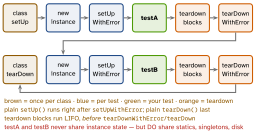
class func setUp()once per class → for each test: new instance →setUpWithError()→setUp()→test…→addTeardownBlocks (LIFO) →tearDownWithError()→tearDown()→ …class func tearDown()once. - Prefer the
WithErrorvariants: theythrows, so setup cantryand a throw fails the test cleanly (notry!). - Instance state is fresh, but statics, singletons,
UserDefaults, files are not — and the instance lives on in the runner: nil the SUT intearDown. - Asserts:
XCTAssertEqual/NotEqual·True/False·Nil/NotNil·Identical(===) ·GreaterThan…·XCTAssertThrowsError(expr){ err in … }·XCTAssertNoThrow·XCTFail("msg")(unconditional) ·try XCTUnwrap(opt)(fail+stop, not crash) ·throw XCTSkip/XCTSkipIf. All takemessage, capturefile/line. - Performance:
measure { }runs the block several times, compares the average to a stored baseline (per device+OS).measure(metrics:)withXCTClockMetric·XCTCPUMetric·XCTMemoryMetric·XCTStorageMetric·XCTOSSignpostMetric. Baselines don’t transfer between machines. - Test plan (
.xctestplan): configurations (locale, env, sanitizers), random order, parallel, repetitions, coverage.
Example — the leak test (you were PARTIAL)
func test_viewModel_isDeallocated() {
  weak var weakRef: FeedViewModel?
  do {                              // inner scope = release point
    let sut = FeedViewModel(api: StubAPI())
    weakRef = sut                   // observe WITHOUT retaining
    sut.start()                     // code that may cycle
  }                                 // last strong ref gone here
  XCTAssertNil(weakRef, "leak: retain cycle keeps VM alive")
}
// reusable form — run AFTER the test body, for every makeSUT():
func trackForLeaks(_ o: AnyObject, line: UInt = #line) {
  addTeardownBlock { [weak o] in
    XCTAssertNil(o, "leaked", line: line) }
}
Picture — one test class, two tests
XCTest vs Swift Testing
| XCTest | Swift Testing | |
|---|---|---|
| declare | func test…() in XCTestCase | @Test func any() (free or in type) |
| group | the class | @Suite struct (fresh per test) |
| setup/teardown | setUp/tearDown | init / deinit |
| soft check | XCTAssertEqual(a,b) | #expect(a == b) — shows both values |
| hard check | try XCTUnwrap(x) | try #require(x) (throws, stops) |
| errors | XCTAssertThrowsError | #expect(throws: E.self){…} |
| async wait | XCTestExpectation | await confirmation{…} |
| table tests | loop (one result) | @Test(arguments: […]) — 1 case each |
| traits | — | .disabled .enabled(if:) .tags .timeLimit .bug .serialized |
| parallel | opt-in, sim clones | default, in-process |
| UI / perf | XCUITest, measure | not supported — stay in XCTest |
Interview traps
deinit{print}and Instruments are debugging, not a test — the automated check is weak-ref-then-XCTAssertNil.trackForLeakson a SUT stored invar sutalways fails: teardown blocks run beforetearDownnils it. Create it in a localmakeSUT().XCTUnwrapvs!: a force-unwrap crash kills the whole runner;XCTUnwrapfails one test.- Porting
XCTAssertEqual(a,b)as#expect(a,b)— idiomatic is#expect(a == b). Both frameworks coexist in one target. measureon shared CI flakes — baselines are per device+OS.
Remember
Weak → scope → nil. #expect continues, #require stops. New instance per test; teardown blocks LIFO before tearDown.
Likely questions
- Order of setUp variants? — class setUp once; per test setUpWithError → setUp → test → blocks → tearDown(WithError).
- Test a VM for retain cycles? —
weak varref, drop strong in scope,XCTAssertNil. #expectvs#require? — soft (records, continues) vs hard (throws).- Why parameterized over a loop? — each argument reported and re-runnable alone.
- Measure memory in a test? —
measure(metrics: [XCTMemoryMetric()]).