testing · memo
In one line: Put logic in a ViewModel with protocol-injected dependencies and unit-test its state transitions (fast, in-process); test a Coordinator’s routing decision, not UIKit; keep XCUITest (separate process, accessibility tree) for a few critical journeys; pin snapshots to one device/OS/locale/appearance.
Download PDF Print view LaTeX source
How it works
- ViewModel: a SwiftUI
Viewis an opaque value description — you can’t read what it shows, and@Stateonly lives inside a rendered hierarchy. So: thin View, logic in an@Observable/ObservableObjectVM. Test = construct with doubles → call an input → assert state. A VM that buildsURLSession.shareditself is untestable — DI is the enabler. @MainActorVM → mark the test@MainActorandawaitthe call, or you read stale state. Sequence[.idle,.loading,.loaded]: record via$state.sink(Combine) orwithObservationTracking(@Observablehas no$publisher — assert properties directly).- Model state as an enum (
idle/loading/loaded/error); put formatting in the VM (priceText == "$10.00"); inject@Environmentvalues (locale, scenePhase) as plain params. - Coordinator: inject a navigation abstraction (
Routerprotocol / apath: [Route]) and assert the route produced for an event — a spy recordsshow(.detail(id: 7)); no realpush. - XCUITest:
let app = XCUIApplication(); setlaunchArguments/launchEnvironmentbeforeapp.launch(); queryapp.buttons["login_button"];continueAfterFailure = false; sync withwaitForExistence(timeout:);exists≠isHittable. Alerts:addUIInterruptionMonitor. On failure attachXCTAttachment(screenshot:). - Page Object: one type per screen owns the selectors + actions (
LoginPage.login(email:password:)); tests read as journeys; one place to fix. - Snapshot (Point-Free
swift-snapshot-testing):assertSnapshot(of: view, as: .image(on: .iPhone13))— first run records a reference in__Snapshots__/, later runs assert (compare). Strategies:.image,.json,.dump,.recursiveDescription. Tolerance:.image(precision: 0.98, perceptualPrecision: 0.98).
Example — ViewModel state transition
protocol FeedAPI { func items() async throws -> [Item] }
struct StubFeedAPI: FeedAPI {
  let result: Result<[Item], Error>
  func items() async throws -> [Item] { try result.get() } }

@MainActor func test_load_failure_showsError() async {
  let sut = FeedViewModel(api: StubFeedAPI(result: .failure(URLError(.notConnectedToInternet))))
  var seen: [FeedState] = []
  let c = sut.$state.sink { seen.append($0) }   // record sequence
  await sut.load()
  XCTAssertEqual(seen, [.idle, .loading, .error("Offline")])
  _ = c
}
UI test skeleton — stub + Page Object
override func setUpWithError() throws {
  continueAfterFailure = false
  app.launchArguments += ["-uitesting", "-disableAnimations"]
  app.launchEnvironment["API_BASE"] = "http://localhost:9999"
  app.launch() }                       // args BEFORE launch
func test_login_showsWelcome() {
  LoginPage(app: app).login(email: "a@b.co", password: "pw")
  let welcome = app.staticTexts["welcome"]      // an identifier
  XCTAssertTrue(welcome.waitForExistence(timeout: 5)) }
// app side, at launch:
if CommandLine.arguments.contains("-uitesting") { useStubs() }
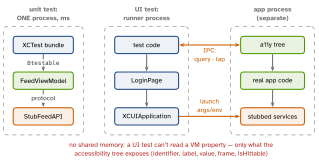
Picture — where each kind of test runs
Coordinator test — spy the navigation
final class SpyRouter: Router {              // Router = protocol
  var shown: [Route] = []
  func show(_ r: Route) { shown.append(r) } }
func test_selectingItem_routesToDetail() {
  let router = SpyRouter()
  let sut = FeedCoordinator(router: router)
  sut.didSelect(Item(id: 7))                   // the event
  XCTAssertEqual(router.shown, [.detail(id: 7)]) }  // the DECISION
Interview traps
accessibilityIdentifier= test hook, never localized, never read aloud;accessibilityLabel= VoiceOver text, localized. Query by label → passes locally, fails on adeCI or a copy edit.sleep(3)before a tap: flaky when short, slow when long, waits for time not the event →waitForExistence.- Pointing UI tests at the real backend: nondeterministic, slow, may mutate prod. Stub via
launchEnvironment["API_BASE"]/ a-uitestingflag; disable animations. - Record mode committed (
record: .all): it always fails and rewrites goldens. And “just re-record” green-lights real regressions — review the diff. - Snapshot passes locally, fails on CI: recorded on a different simulator/OS/scale. Pin device, OS, locale,
userInterfaceStyle, content size; inject fixed dates/IDs. - “80% View coverage via ViewInspector” = logic lives in Views + brittle structure tests.
Remember
VM: inject → drive → assert state. UI test: ID, wait, stub, Page Object, few. Snapshot: pin, record once, review diffs.
Likely questions
- Why not unit-test a SwiftUI View? — opaque
body;@Stateis runtime-owned. - Test a Coordinator? — fake nav/router; assert the route chosen, not the push.
- Stub the backend in XCUITest? — launch args/env read at app start → stub services.
- Can a UI test read VM state? — no; separate process, a11y tree only.
- Record vs assert? — record writes the reference (and fails); assert compares.