testing · memo
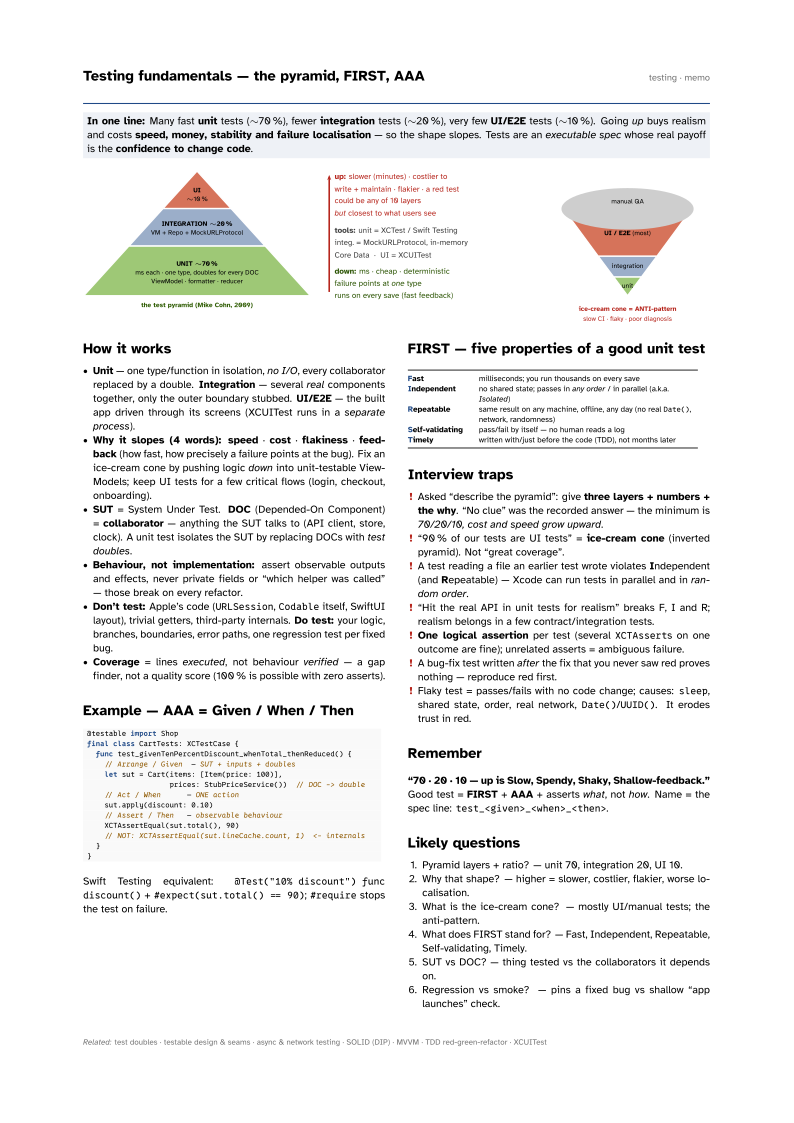
In one line: Many fast unit tests (∼70 %), fewer integration tests (∼20 %), very few UI/E2E tests (∼10 %). Going up buys realism and costs speed, money, stability and failure localisation — so the shape slopes. Tests are an executable spec whose real payoff is the confidence to change code.
Download PDF Print view LaTeX source
How it works
- Unit — one type/function in isolation, no I/O, every collaborator replaced by a double. Integration — several real components together, only the outer boundary stubbed. UI/E2E — the built app driven through its screens (XCUITest runs in a separate process).
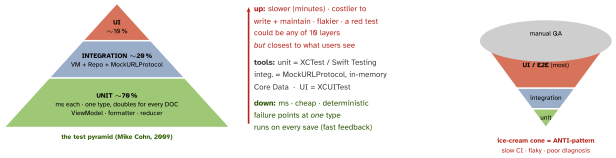
- Why it slopes (4 words): speed · cost · flakiness · feedback (how fast, how precisely a failure points at the bug). Fix an ice-cream cone by pushing logic down into unit-testable ViewModels; keep UI tests for a few critical flows (login, checkout, onboarding).
- SUT = System Under Test. DOC (Depended-On Component) = collaborator — anything the SUT talks to (API client, store, clock). A unit test isolates the SUT by replacing DOCs with test doubles.
- Behaviour, not implementation: assert observable outputs and effects, never private fields or “which helper was called” — those break on every refactor.
- Don’t test: Apple’s code (
URLSession,Codableitself, SwiftUI layout), trivial getters, third-party internals. Do test: your logic, branches, boundaries, error paths, one regression test per fixed bug. - Coverage = lines executed, not behaviour verified — a gap finder, not a quality score (100 % is possible with zero asserts).
Example — AAA = Given / When / Then
@testable import Shop
final class CartTests: XCTestCase {
  func test_givenTenPercentDiscount_whenTotal_thenReduced() {
    // Arrange / Given  — SUT + inputs + doubles
    let sut = Cart(items: [Item(price: 100)],
                   prices: StubPriceService())  // DOC -> double
    // Act / When      — ONE action
    sut.apply(discount: 0.10)
    // Assert / Then   — observable behaviour
    XCTAssertEqual(sut.total(), 90)
    // NOT: XCTAssertEqual(sut.lineCache.count, 1)  <- internals
  }
}
Swift Testing equivalent: @Test("10% discount") func discount() + #expect(sut.total() == 90); #require stops the test on failure.
FIRST — five properties of a good unit test
| Fast | milliseconds; you run thousands on every save |
| Independent | no shared state; passes in any order / in parallel (a.k.a. Isolated) |
| Repeatable | same result on any machine, offline, any day (no real Date(), network, randomness) |
| Self-validating | pass/fail by itself — no human reads a log |
| Timely | written with/just before the code (TDD), not months later |
Interview traps
- Asked “describe the pyramid”: give three layers + numbers + the why. “No clue” was the recorded answer — the minimum is 70/20/10, cost and speed grow upward.
- “90 % of our tests are UI tests” = ice-cream cone (inverted pyramid). Not “great coverage”.
- A test reading a file an earlier test wrote violates Independent (and Repeatable) — Xcode can run tests in parallel and in random order.
- “Hit the real API in unit tests for realism” breaks F, I and R; realism belongs in a few contract/integration tests.
- One logical assertion per test (several
XCTAsserts on one outcome are fine); unrelated asserts = ambiguous failure. - A bug-fix test written after the fix that you never saw red proves nothing — reproduce red first.
- Flaky test = passes/fails with no code change; causes:
sleep, shared state, order, real network,Date()/UUID(). It erodes trust in red.
Remember
“70 · 20 · 10 — up is Slow, Spendy, Shaky, Shallow-feedback.” Good test = FIRST + AAA + asserts what, not how. Name = the spec line: test_<given>_<when>_<then>.
Likely questions
- Pyramid layers + ratio? — unit 70, integration 20, UI 10.
- Why that shape? — higher = slower, costlier, flakier, worse localisation.
- What is the ice-cream cone? — mostly UI/manual tests; the anti-pattern.
- What does FIRST stand for? — Fast, Independent, Repeatable, Self-validating, Timely.
- SUT vs DOC? — thing tested vs the collaborators it depends on.
- Regression vs smoke? — pins a fixed bug vs shallow “app launches” check.