testing · memo
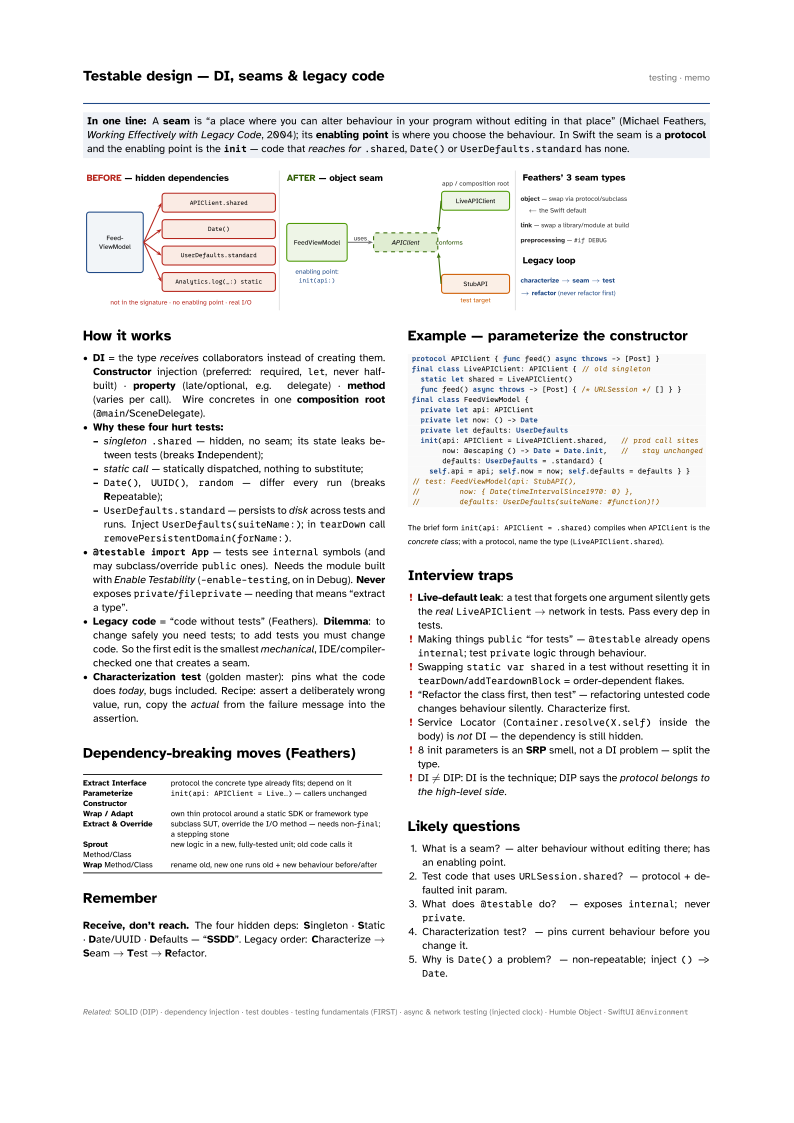
In one line: A seam is “a place where you can alter behaviour in your program without
editing in that place” (Michael Feathers, Working Effectively with Legacy Code, 2004);
its enabling point is where you choose the behaviour. In Swift the seam is a
protocol and the enabling point is the init — code that
reaches for .shared, Date() or UserDefaults.standard has none.
Download PDF Print view LaTeX source
How it works
- DI = the type receives collaborators instead of creating them. Constructor injection (preferred: required,
let, never half-built) · property (late/optional, e.g. delegate) · method (varies per call). Wire concretes in one composition root (@main/SceneDelegate). Why these four hurt tests:
- singleton
.shared— hidden, no seam; its state leaks between tests (breaks Independent); - static call — statically dispatched, nothing to substitute;
Date(),UUID(),random— differ every run (breaks Repeatable);UserDefaults.standard— persists to disk across tests and runs. InjectUserDefaults(suiteName:); intearDowncallremovePersistentDomain(forName:).
- singleton
@testable import App— tests seeinternalsymbols (and may subclass/overridepublicones). Needs the module built with Enable Testability (-enable-testing, on in Debug). Never exposesprivate/fileprivate— needing that means “extract a type”.- Legacy code = “code without tests” (Feathers). Dilemma: to change safely you need tests; to add tests you must change code. So the first edit is the smallest mechanical, IDE/compiler-checked one that creates a seam.
- Characterization test (golden master): pins what the code does today, bugs included. Recipe: assert a deliberately wrong value, run, copy the actual from the failure message into the assertion.
Dependency-breaking moves (Feathers)
| Extract Interface | protocol the concrete type already fits; depend on it |
| Parameterize Constructor | init(api: APIClient = Live…) — callers unchanged |
| Wrap / Adapt | own thin protocol around a static SDK or framework type |
| Extract & Override | subclass SUT, override the I/O method — needs non-final; a stepping stone |
| Sprout Method/Class | new logic in a new, fully-tested unit; old code calls it |
| Wrap Method/Class | rename old, new one runs old + new behaviour before/after |
Remember
Receive, don’t reach. The four hidden deps: Singleton · Static · Date/UUID · Defaults — “SSDD”. Legacy order: Characterize → Seam → Test → Refactor.
Example — parameterize the constructor
protocol APIClient { func feed() async throws -> [Post] }
final class LiveAPIClient: APIClient { // old singleton
  static let shared = LiveAPIClient()
  func feed() async throws -> [Post] { /* URLSession */ [] } }
final class FeedViewModel {
  private let api: APIClient
  private let now: () -> Date
  private let defaults: UserDefaults
  init(api: APIClient = LiveAPIClient.shared,   // prod call sites
       now: @escaping () -> Date = Date.init,   //   stay unchanged
       defaults: UserDefaults = .standard) {
    self.api = api; self.now = now; self.defaults = defaults } }
// test: FeedViewModel(api: StubAPI(),
//         now: { Date(timeIntervalSince1970: 0) },
//         defaults: UserDefaults(suiteName: #function)!)
The brief form init(api: APIClient = .shared) compiles when
APIClient is the concrete class; with a protocol, name the type
(LiveAPIClient.shared).
Interview traps
- Live-default leak: a test that forgets one argument silently gets the real
LiveAPIClient→ network in tests. Pass every dep in tests. - Making things
public“for tests” —@testablealready opensinternal; testprivatelogic through behaviour. - Swapping
static var sharedin a test without resetting it intearDown/addTeardownBlock= order-dependent flakes. - “Refactor the class first, then test” — refactoring untested code changes behaviour silently. Characterize first.
- Service Locator (
Container.resolve(X.self)inside the body) is not DI — the dependency is still hidden. - 8 init parameters is an SRP smell, not a DI problem — split the type.
- DI ≠ DIP: DI is the technique; DIP says the protocol belongs to the high-level side.
Likely questions
- What is a seam? — alter behaviour without editing there; has an enabling point.
- Test code that uses
URLSession.shared? — protocol + defaulted init param. - What does
@testabledo? — exposesinternal; neverprivate. - Characterization test? — pins current behaviour before you change it.
- Why is
Date()a problem? — non-repeatable; inject() -> Date.