testing · memo
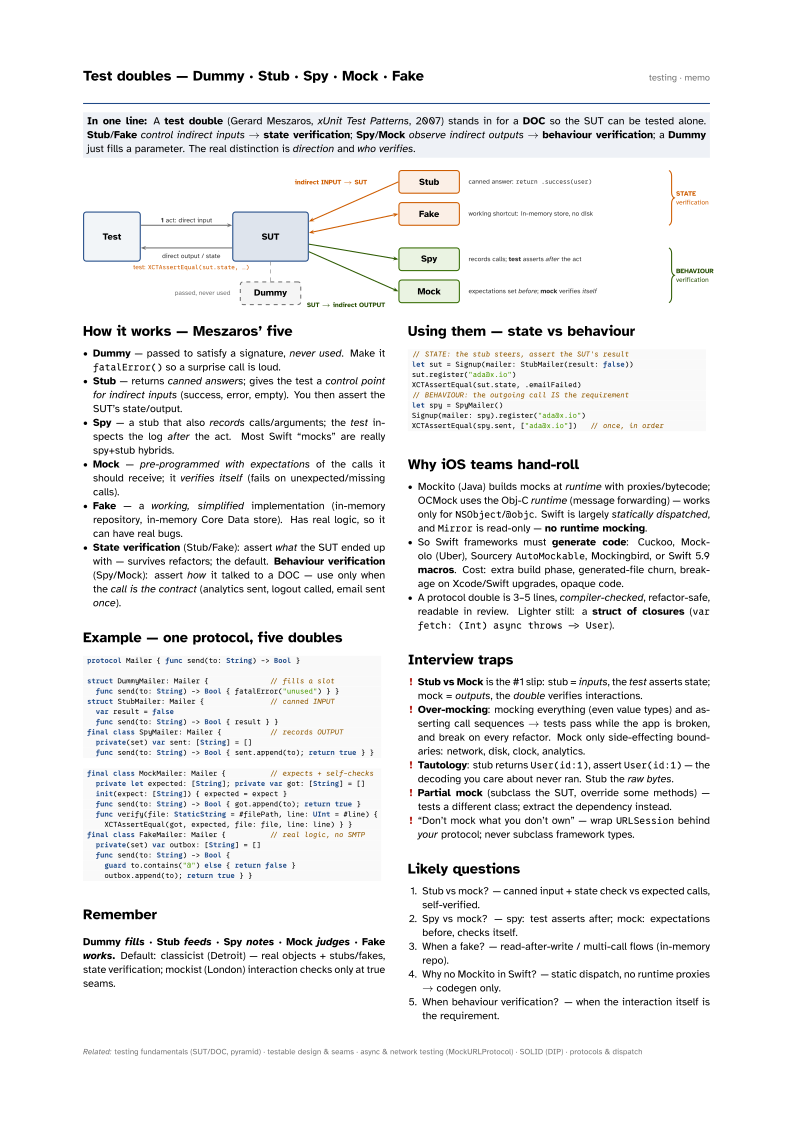
In one line: A test double (Gerard Meszaros, xUnit Test Patterns, 2007) stands in for a DOC so the SUT can be tested alone. Stub/Fake control indirect inputs → state verification; Spy/Mock observe indirect outputs → behaviour verification; a Dummy just fills a parameter. The real distinction is direction and who verifies.
Download PDF Print view LaTeX source
How it works — Meszaros’ five
- Dummy — passed to satisfy a signature, never used. Make it
fatalError()so a surprise call is loud. - Stub — returns canned answers; gives the test a control point for indirect inputs (success, error, empty). You then assert the SUT’s state/output.
- Spy — a stub that also records calls/arguments; the test inspects the log after the act. Most Swift “mocks” are really spy+stub hybrids.
- Mock — pre-programmed with expectations of the calls it should receive; it verifies itself (fails on unexpected/missing calls).
- Fake — a working, simplified implementation (in-memory repository, in-memory Core Data store). Has real logic, so it can have real bugs.
- State verification (Stub/Fake): assert what the SUT ended up with — survives refactors; the default. Behaviour verification (Spy/Mock): assert how it talked to a DOC — use only when the call is the contract (analytics sent, logout called, email sent once).
Example — one protocol, five doubles
protocol Mailer { func send(to: String) -> Bool }

struct DummyMailer: Mailer {              // fills a slot
  func send(to: String) -> Bool { fatalError("unused") } }
struct StubMailer: Mailer {               // canned INPUT
  var result = false
  func send(to: String) -> Bool { result } }
final class SpyMailer: Mailer {           // records OUTPUT
  private(set) var sent: [String] = []
  func send(to: String) -> Bool { sent.append(to); return true } }
final class MockMailer: Mailer { // expects + self-checks
private let expected: [String]; private var got: [String] = []
init(expect: [String]) { expected = expect }
func send(to: String) -> Bool { got.append(to); return true }
func verify(file: StaticString = #filePath, line: UInt = #line) {
XCTAssertEqual(got, expected, file: file, line: line) } }
final class FakeMailer: Mailer { // real logic, no SMTP
private(set) var outbox: [String] = []
func send(to: String) -> Bool {
guard to.contains("@") else { return false }
outbox.append(to); return true } }Remember
Dummy fills · Stub feeds · Spy notes · Mock judges · Fake works. Default: classicist (Detroit) — real objects + stubs/fakes, state verification; mockist (London) interaction checks only at true seams.
Using them — state vs behaviour
// STATE: the stub steers, assert the SUT's result
let sut = Signup(mailer: StubMailer(result: false))
sut.register("ada@x.io")
XCTAssertEqual(sut.state, .emailFailed)
// BEHAVIOUR: the outgoing call IS the requirement
let spy = SpyMailer()
Signup(mailer: spy).register("ada@x.io")
XCTAssertEqual(spy.sent, ["ada@x.io"])   // once, in order
Why iOS teams hand-roll
- Mockito (Java) builds mocks at runtime with proxies/bytecode; OCMock uses the Obj-C runtime (message forwarding) — works only for
NSObject/@objc. Swift is largely statically dispatched, andMirroris read-only — no runtime mocking. - So Swift frameworks must generate code: Cuckoo, Mockolo (Uber), Sourcery
AutoMockable, Mockingbird, or Swift 5.9 macros. Cost: extra build phase, generated-file churn, breakage on Xcode/Swift upgrades, opaque code. - A protocol double is 3–5 lines, compiler-checked, refactor-safe, readable in review. Lighter still: a struct of closures (
var fetch: (Int) async throws -> User).
Interview traps
- Stub vs Mock is the #1 slip: stub = inputs, the test asserts state; mock = outputs, the double verifies interactions.
- Over-mocking: mocking everything (even value types) and asserting call sequences → tests pass while the app is broken, and break on every refactor. Mock only side-effecting boundaries: network, disk, clock, analytics.
- Tautology: stub returns
User(id:1), assertUser(id:1)— the decoding you care about never ran. Stub the raw bytes. - Partial mock (subclass the SUT, override some methods) — tests a different class; extract the dependency instead.
- “Don’t mock what you don’t own” — wrap
URLSessionbehind your protocol; never subclass framework types.
Likely questions
- Stub vs mock? — canned input + state check vs expected calls, self-verified.
- Spy vs mock? — spy: test asserts after; mock: expectations before, checks itself.
- When a fake? — read-after-write / multi-call flows (in-memory repo).
- Why no Mockito in Swift? — static dispatch, no runtime proxies → codegen only.
- When behaviour verification? — when the interaction itself is the requirement.