testing · memo
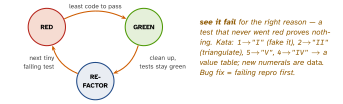
In one line: A flaky test has a nondeterminism source — shared state, order, real time, real network, animations, concurrency, environment — so remove the source, never retry. Coverage says what ran, not what was verified. TDD = Red → Green → Refactor in minute-long cycles; the failing test comes first.
Download PDF Print view LaTeX source
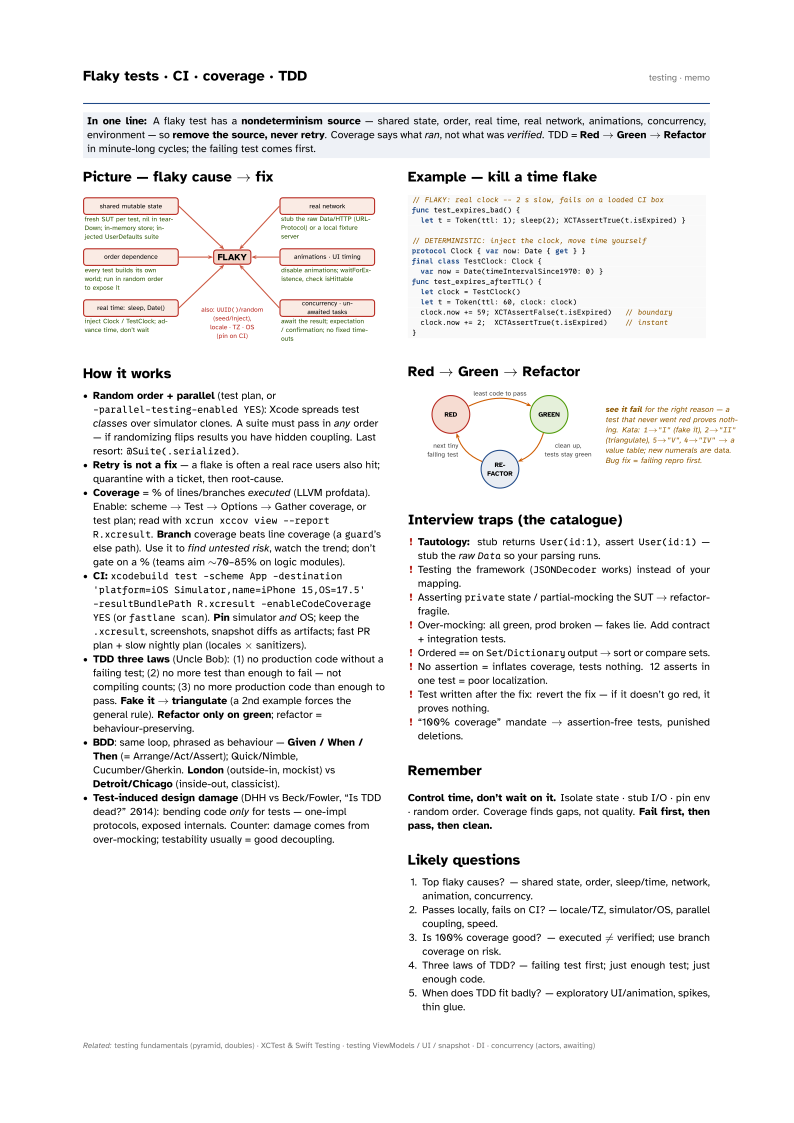
Picture — flaky cause → fix
How it works
- Random order + parallel (test plan, or
-parallel-testing-enabled YES): Xcode spreads test classes over simulator clones. A suite must pass in any order — if randomizing flips results you have hidden coupling. Last resort:@Suite(.serialized). - Retry is not a fix — a flake is often a real race users also hit; quarantine with a ticket, then root-cause.
- Coverage = % of lines/branches executed (LLVM profdata). Enable: scheme → Test → Options → Gather coverage, or test plan; read with
xcrun xccov view --report R.xcresult. Branch coverage beats line coverage (aguard’s else path). Use it to find untested risk, watch the trend; don’t gate on a % (teams aim ∼70–85% on logic modules). - CI:
xcodebuild test -scheme App -destination 'platform=iOS Simulator,name=iPhone 15,OS=17.5' -resultBundlePath R.xcresult -enableCodeCoverage YES(orfastlane scan). Pin simulator and OS; keep the.xcresult, screenshots, snapshot diffs as artifacts; fast PR plan + slow nightly plan (locales × sanitizers). - TDD three laws (Uncle Bob): (1) no production code without a failing test; (2) no more test than enough to fail — not compiling counts; (3) no more production code than enough to pass. Fake it → triangulate (a 2nd example forces the general rule). Refactor only on green; refactor = behaviour-preserving.
- BDD: same loop, phrased as behaviour — Given / When / Then (= Arrange/Act/Assert); Quick/Nimble, Cucumber/Gherkin. London (outside-in, mockist) vs Detroit/Chicago (inside-out, classicist).
- Test-induced design damage (DHH vs Beck/Fowler, “Is TDD dead?” 2014): bending code only for tests — one-impl protocols, exposed internals. Counter: damage comes from over-mocking; testability usually = good decoupling.
Example — kill a time flake
// FLAKY: real clock -- 2 s slow, fails on a loaded CI box
func test_expires_bad() {
  let t = Token(ttl: 1); sleep(2); XCTAssertTrue(t.isExpired) }

// DETERMINISTIC: inject the clock, move time yourself
protocol Clock { var now: Date { get } }
final class TestClock: Clock {
  var now = Date(timeIntervalSince1970: 0) }
func test_expires_afterTTL() {
  let clock = TestClock()
  let t = Token(ttl: 60, clock: clock)
  clock.now += 59; XCTAssertFalse(t.isExpired)   // boundary
  clock.now += 2;  XCTAssertTrue(t.isExpired)    // instant
}
Red → Green → Refactor
Interview traps (the catalogue)
- Tautology: stub returns
User(id:1), assertUser(id:1)— stub the rawDataso your parsing runs. - Testing the framework (
JSONDecoderworks) instead of your mapping. - Asserting
privatestate / partial-mocking the SUT → refactor-fragile. - Over-mocking: all green, prod broken — fakes lie. Add contract + integration tests.
- Ordered
==onSet/Dictionaryoutput → sort or compare sets. - No assertion = inflates coverage, tests nothing. 12 asserts in one test = poor localization.
- Test written after the fix: revert the fix — if it doesn’t go red, it proves nothing.
- “100% coverage” mandate → assertion-free tests, punished deletions.
Remember
Control time, don’t wait on it. Isolate state · stub I/O · pin env · random order. Coverage finds gaps, not quality. Fail first, then pass, then clean.
Likely questions
- Top flaky causes? — shared state, order, sleep/time, network, animation, concurrency.
- Passes locally, fails on CI? — locale/TZ, simulator/OS, parallel coupling, speed.
- Is 100% coverage good? — executed ≠ verified; use branch coverage on risk.
- Three laws of TDD? — failing test first; just enough test; just enough code.
- When does TDD fit badly? — exploratory UI/animation, spikes, thin glue.