runtime · memo
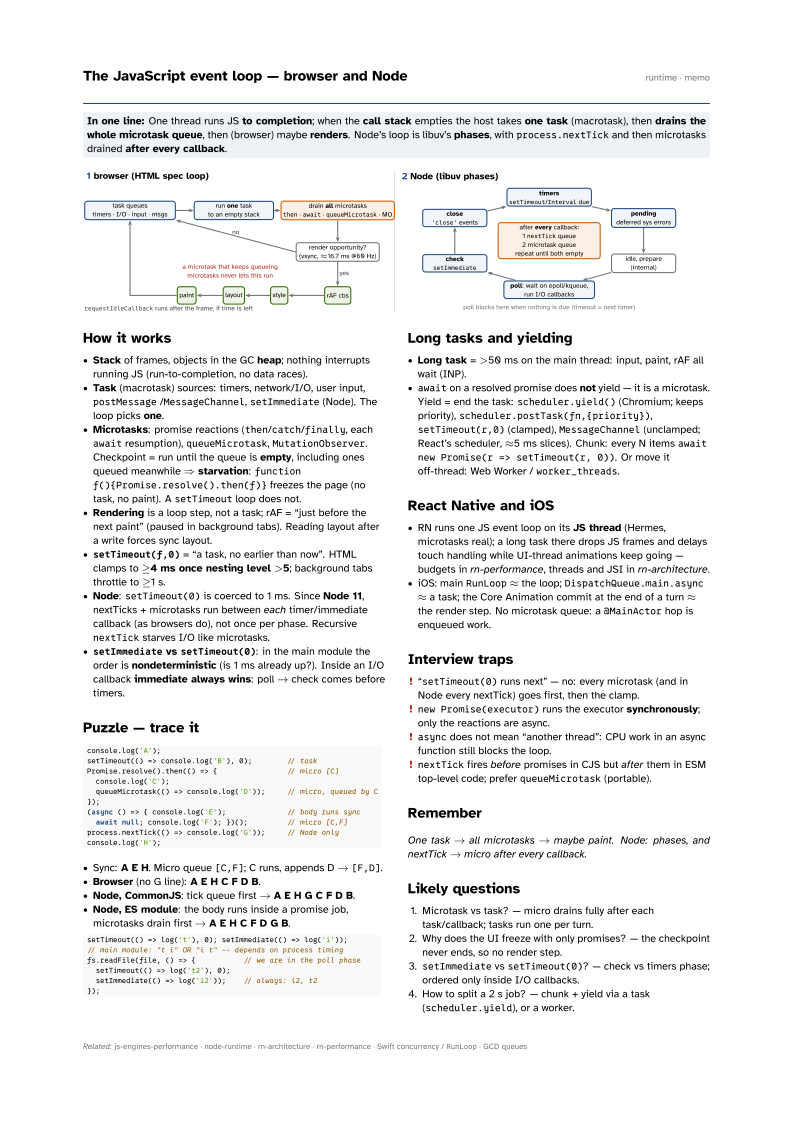
In one line: One thread runs JS to completion; when the call stack empties the
host takes one task (macrotask), then drains the whole microtask queue, then
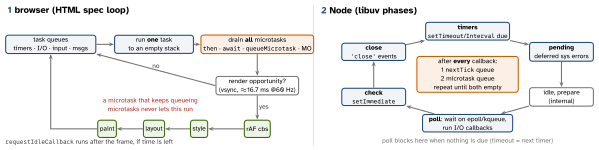
(browser) maybe renders. Node’s loop is libuv’s phases, with
process.nextTick and then microtasks drained after every callback.
Download PDF Print view LaTeX source
How it works
- Stack of frames, objects in the GC heap; nothing interrupts running JS (run-to-completion, no data races).
- Task (macrotask) sources: timers, network/I/O, user input,
postMessage/MessageChannel,setImmediate(Node). The loop picks one. - Microtasks: promise reactions (
then/catch/finally, eachawaitresumption),queueMicrotask,MutationObserver. Checkpoint = run until the queue is empty, including ones queued meanwhile ⇒ starvation:function f(){Promise.resolve().then(f)}freezes the page (no task, no paint). AsetTimeoutloop does not. - Rendering is a loop step, not a task; rAF = “just before the next paint” (paused in background tabs). Reading layout after a write forces sync layout.
setTimeout(f,0)= “a task, no earlier than now”. HTML clamps to ≥4 ms once nesting level >5; background tabs throttle to ≥1 s.- Node:
setTimeout(0)is coerced to 1 ms. Since Node 11, nextTicks + microtasks run between each timer/immediate callback (as browsers do), not once per phase. RecursivenextTickstarves I/O like microtasks. setImmediatevssetTimeout(0): in the main module the order is nondeterministic (is 1 ms already up?). Inside an I/O callback immediate always wins: poll → check comes before timers.
Puzzle — trace it
console.log('A');
setTimeout(() => console.log('B'), 0);        // task
Promise.resolve().then(() => {                // micro [C]
  console.log('C');
  queueMicrotask(() => console.log('D'));     // micro, queued by C
});
(async () => { console.log('E');              // body runs sync
  await null; console.log('F'); })();         // micro [C,F]
process.nextTick(() => console.log('G'));     // Node only
console.log('H');- Sync: A E H. Micro queue
[C,F]; C runs, appends D →[F,D]. - Browser (no G line): A E H C F D B.
- Node, CommonJS: tick queue first → A E H G C F D B.
- Node, ES module: the body runs inside a promise job, microtasks drain first → A E H C F D G B.
setTimeout(() => log('t'), 0); setImmediate(() => log('i'));
// main module: "t i" OR "i t" -- depends on process timing
fs.readFile(file, () => {           // we are in the poll phase
  setTimeout(() => log('t2'), 0);
  setImmediate(() => log('i2'));    // always: i2, t2
});
Long tasks and yielding
- Long task = >50 ms on the main thread: input, paint, rAF all wait (INP).
awaiton a resolved promise does not yield — it is a microtask. Yield = end the task:scheduler.yield()(Chromium; keeps priority),scheduler.postTask(fn,{priority}),setTimeout(r,0)(clamped),MessageChannel(unclamped; React’s scheduler, ≈5 ms slices). Chunk: every N itemsawait new Promise(r =0pt> setTimeout(r, 0)). Or move it off-thread: Web Worker /worker_threads.
React Native and iOS
- RN runs one JS event loop on its JS thread (Hermes, microtasks real); a long task there drops JS frames and delays touch handling while UI-thread animations keep going — budgets in rn-performance, threads and JSI in rn-architecture.
- iOS: main
RunLoop≈ the loop;DispatchQueue.main.async≈ a task; the Core Animation commit at the end of a turn ≈ the render step. No microtask queue: a@MainActorhop is enqueued work.
Interview traps
- “
setTimeout(0)runs next” — no: every microtask (and in Node every nextTick) goes first, then the clamp. new Promise(executor)runs the executor synchronously; only the reactions are async.asyncdoes not mean “another thread”: CPU work in an async function still blocks the loop.nextTickfires before promises in CJS but after them in ESM top-level code; preferqueueMicrotask(portable).
Remember
One task → all microtasks → maybe paint. Node: phases, and nextTick → micro after every callback.
Likely questions
- Microtask vs task? — micro drains fully after each task/callback; tasks run one per turn.
- Why does the UI freeze with only promises? — the checkpoint never ends, so no render step.
setImmediatevssetTimeout(0)? — check vs timers phase; ordered only inside I/O callbacks.- How to split a 2 s job? — chunk + yield via a task (
scheduler.yield), or a worker.