runtime · memo
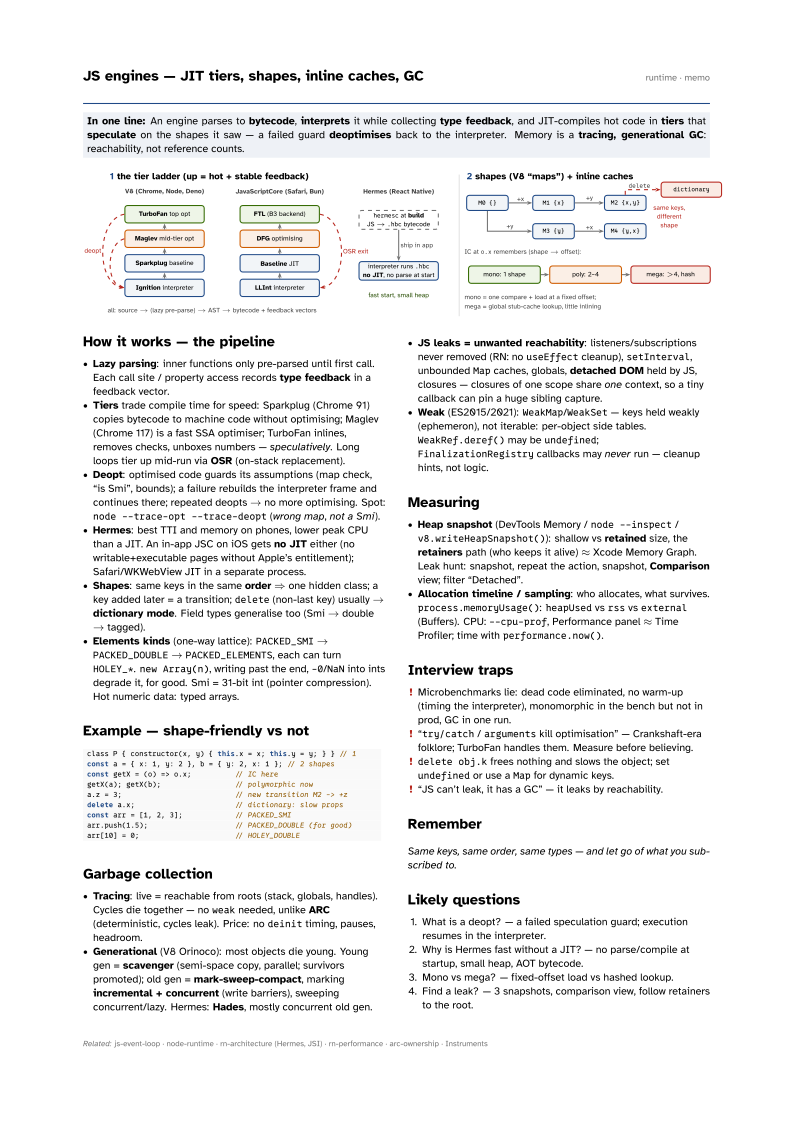
In one line: An engine parses to bytecode, interprets it while collecting type feedback, and JIT-compiles hot code in tiers that speculate on the shapes it saw — a failed guard deoptimises back to the interpreter. Memory is a tracing, generational GC: reachability, not reference counts.
Download PDF Print view LaTeX source
How it works — the pipeline
- Lazy parsing: inner functions only pre-parsed until first call. Each call site / property access records type feedback in a feedback vector.
- Tiers trade compile time for speed: Sparkplug (Chrome 91) copies bytecode to machine code without optimising; Maglev (Chrome 117) is a fast SSA optimiser; TurboFan inlines, removes checks, unboxes numbers — speculatively. Long loops tier up mid-run via OSR (on-stack replacement).
- Deopt: optimised code guards its assumptions (map check, “is Smi”, bounds); a failure rebuilds the interpreter frame and continues there; repeated deopts → no more optimising. Spot:
node --trace-opt --trace-deopt(wrong map, not a Smi). - Hermes: best TTI and memory on phones, lower peak CPU than a JIT. An in-app JSC on iOS gets no JIT either (no writable+executable pages without Apple’s entitlement); Safari/WKWebView JIT in a separate process.
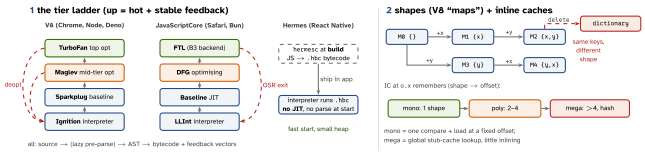
- Shapes: same keys in the same order ⇒ one hidden class; a key added later = a transition;
delete(non-last key) usually → dictionary mode. Field types generalise too (Smi → double → tagged). - Elements kinds (one-way lattice):
PACKED_SMI→PACKED_DOUBLE→PACKED_ELEMENTS, each can turnHOLEY_*.new Array(n), writing past the end,-0/NaNinto ints degrade it, for good. Smi = 31-bit int (pointer compression). Hot numeric data: typed arrays.
Example — shape-friendly vs not
class P { constructor(x, y) { this.x = x; this.y = y; } } // 1
const a = { x: 1, y: 2 }, b = { y: 2, x: 1 }; // 2 shapes
const getX = (o) => o.x;          // IC here
getX(a); getX(b);                 // polymorphic now
a.z = 3;                          // new transition M2 -> +z
delete a.x;                       // dictionary: slow props
const arr = [1, 2, 3];            // PACKED_SMI
arr.push(1.5);                    // PACKED_DOUBLE (for good)
arr[10] = 0;                      // HOLEY_DOUBLE
Garbage collection
- Tracing: live = reachable from roots (stack, globals, handles). Cycles die together — no
weakneeded, unlike ARC (deterministic, cycles leak). Price: nodeinittiming, pauses, headroom. - Generational (V8 Orinoco): most objects die young. Young gen = scavenger (semi-space copy, parallel; survivors promoted); old gen = mark-sweep-compact, marking incremental + concurrent (write barriers), sweeping concurrent/lazy. Hermes: Hades, mostly concurrent old gen.
- JS leaks = unwanted reachability: listeners/subscriptions never removed (RN: no
useEffectcleanup),setInterval, unboundedMapcaches, globals, detached DOM held by JS, closures — closures of one scope share one context, so a tiny callback can pin a huge sibling capture. - Weak (ES2015/2021):
WeakMap/WeakSet— keys held weakly (ephemeron), not iterable: per-object side tables.WeakRef.deref()may beundefined;FinalizationRegistrycallbacks may never run — cleanup hints, not logic.
Measuring
- Heap snapshot (DevTools Memory /
node --inspect/v8.writeHeapSnapshot()): shallow vs retained size, the retainers path (who keeps it alive) ≈ Xcode Memory Graph. Leak hunt: snapshot, repeat the action, snapshot, Comparison view; filter “Detached”. - Allocation timeline / sampling: who allocates, what survives.
process.memoryUsage():heapUsedvsrssvsexternal(Buffers). CPU:--cpu-prof, Performance panel ≈ Time Profiler; time withperformance.now().
Interview traps
- Microbenchmarks lie: dead code eliminated, no warm-up (timing the interpreter), monomorphic in the bench but not in prod, GC in one run.
- “
try/catch/argumentskill optimisation” — Crankshaft-era folklore; TurboFan handles them. Measure before believing. delete obj.kfrees nothing and slows the object; setundefinedor use aMapfor dynamic keys.- “JS can’t leak, it has a GC” — it leaks by reachability.
Remember
Same keys, same order, same types — and let go of what you subscribed to.
Likely questions
- What is a deopt? — a failed speculation guard; execution resumes in the interpreter.
- Why is Hermes fast without a JIT? — no parse/compile at startup, small heap, AOT bytecode.
- Mono vs mega? — fixed-offset load vs hashed lookup.
- Find a leak? — 3 snapshots, comparison view, follow retainers to the root.