react-native · memo
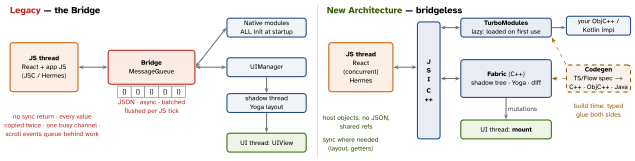
In one line: React runs on a JS thread; real native views live on the UI thread. The legacy Bridge joined them with async, batched JSON; the New Architecture (default since RN 0.76) uses JSI — JS calls C++ directly, sync or async — with the Fabric renderer and lazy, typed TurboModules generated by Codegen.
Download PDF Print view LaTeX source
Threads — who owns what
- JS thread (one): render, logic, handlers. Block it and JS-driven taps and animations freeze, yet native scrolling still works. Perf Monitor: JS FPS ≠ UI FPS.
- Main/UI thread:
UIViews, gestures, native animations — iOS main-thread rules unchanged. iOS map: JS thread ≈ a serial queue owning the model; UI =DispatchQueue.main. - Background: legacy shadow thread ran Yoga; legacy modules ran on their own
methodQueue(GCD). Fabric lays out on JS or a background thread.
Why the Bridge bottlenecked
- Every call: serialise JSON → queue → batch-flush → parse. Async
only — no native value in the same frame (
measure→ layout jump). - One channel: list updates and
onScrollfloods compete. All modules init at startup (slow TTI); untyped → runtime crashes on bad args.
New Architecture — the pieces
- JSI: engine-agnostic C++ API (
jsi::Runtime,HostObject,HostFunction). JS holds a C++ reference and calls it — no serialisation, sync possible. - Fabric: C++ renderer shared iOS/Android. Immutable shadow tree (clone-on-write, thread-safe), diff in C++, view flattening (layout-only Views get no native view). Enables concurrent React and sync layout reads (
useLayoutEffectwithout flicker). - TurboModules: native modules over JSI, lazy (first access), typed.
- Codegen: at build (pod install / Gradle) turns the TS/Flow spec into C++ glue + ObjC++ protocol (
NativeFooSpec) + Java class. Wrong type = compile error. - Bridgeless: no Bridge object at all. Interop layer: legacy
RCT_EXPORT_MODULEmodules andrequireNativeComponentviews still run — the migration path.
Example — a TurboModule spec
// specs/NativeHaptics.ts   (name MUST start "Native")
import type { TurboModule } from 'react-native';
import { TurboModuleRegistry } from 'react-native';
export interface Spec extends TurboModule {
  isSupported(): boolean;          // SYNC over JSI
  impact(style: string): void;     // fire-and-forget
  prepare(): Promise<void>;        // async, resolves later
}
export default TurboModuleRegistry.getEnforcing<Spec>('Haptics');
// + package.json codegenConfig; iOS .mm adopts <NativeHapticsSpec>
Render → commit → mount
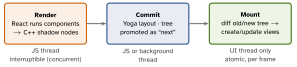
- Several tree revisions: laid out off-main, swapped in atomically — never a half-applied UI. Yoga = C++ flexbox, Auto Layout’s role, solved off-main.
- Finger-tracking UI must not round-trip through JS: native-driven animation (Reanimated worklets,
useNativeDriver).
Hermes — JS engine (default since RN 0.70)
hermesccompiles JS to bytecode at build time; app mmaps it — no parse on device → faster TTI, less RAM. No JIT (JSC in an iOS app has none either). Concurrent GC Hades; debug via Chrome DevTools Protocol (React Native DevTools). Trades peak CPU throughput for startup.
Interview traps
- “JSI makes RN fast” — it cuts boundary cost; JS is still 1 thread.
- A slow sync TurboModule method blocks the JS thread — I/O goes in
Promisemethods. - Bridge cost ≠ just JSON: async-only + one queue + eager init.
- Old remote debugging ran JS in Chrome — impossible with JSI.
- Swift-only module still needs ObjC++ glue — the spec is C++/ObjC++.
Remember
Bridge = mail (JSON letters). JSI = a phone line to C++. Fabric draws, TurboModules serve, Codegen types, Hermes pre-compiles.
Likely questions
- Why did the Bridge limit perf? — async JSON, one queue, eager init.
- Fabric adds? — C++ immutable tree, concurrent React, sync layout.
- Old module? — interop layer first; then TS spec + Codegen.
- Why Hermes? — AOT bytecode: faster start, less RAM.