networking · memo
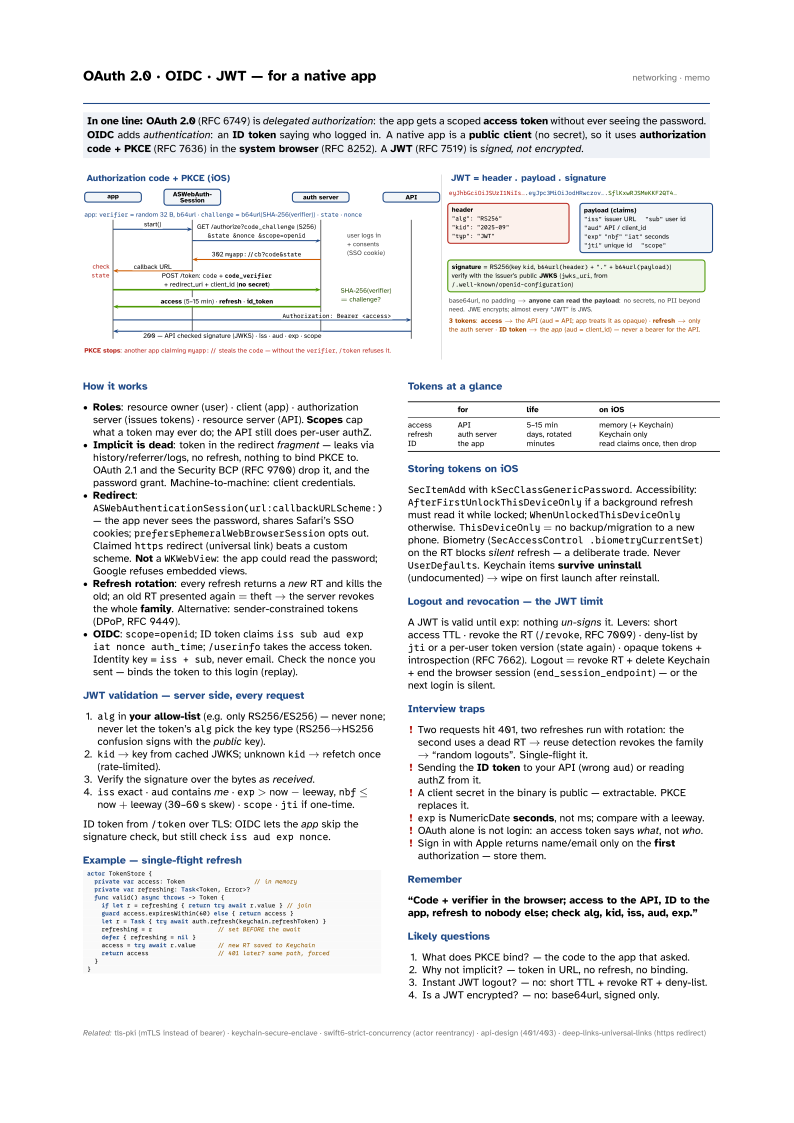
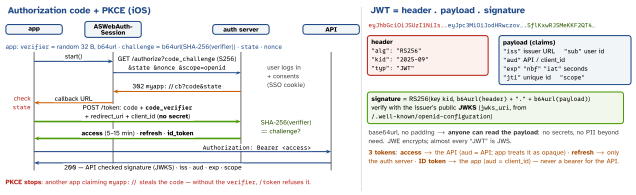
In one line: OAuth 2.0 (RFC 6749) is delegated authorization: the app gets a scoped access token without ever seeing the password. OIDC adds authentication: an ID token saying who logged in. A native app is a public client (no secret), so it uses authorization code + PKCE (RFC 7636) in the system browser (RFC 8252). A JWT (RFC 7519) is signed, not encrypted.
Download PDF Print view LaTeX source
How it works
- Roles: resource owner (user) · client (app) · authorization server (issues tokens) · resource server (API). Scopes cap what a token may ever do; the API still does per-user authZ.
- Implicit is dead: token in the redirect fragment — leaks via history/referrer/logs, no refresh, nothing to bind PKCE to. OAuth 2.1 and the Security BCP (RFC 9700) drop it, and the password grant. Machine-to-machine: client credentials.
- Redirect:
ASWebAuthenticationSession(url:callbackURLScheme:)— the app never sees the password, shares Safari’s SSO cookies;prefersEphemeralWebBrowserSessionopts out. Claimedhttpsredirect (universal link) beats a custom scheme. Not aWKWebView: the app could read the password; Google refuses embedded views. - Refresh rotation: every refresh returns a new RT and kills the old; an old RT presented again = theft → the server revokes the whole family. Alternative: sender-constrained tokens (DPoP, RFC 9449).
- OIDC:
scope=openid; ID token claimsiss sub aud exp iat nonce auth_time;/userinfotakes the access token. Identity key =iss + sub, never email. Check thenonceyou sent — binds the token to this login (replay).
JWT validation — server side, every request
algin your allow-list (e.g. only RS256/ES256) — nevernone; never let the token’salgpick the key type (RS256→HS256 confusion signs with the public key).kid→ key from cached JWKS; unknownkid→ refetch once (rate-limited).- Verify the signature over the bytes as received.
issexact ·audcontains me ·exp> now - leeway,nbf≤ now + leeway (30–60 s skew) ·scope·jtiif one-time.
ID token from /token over TLS: OIDC lets the app skip the signature check, but still check iss aud exp nonce.
Example — single-flight refresh
actor TokenStore {
  private var access: Token                   // in memory
  private var refreshing: Task<Token, Error>?
  func valid() async throws -> Token {
    if let r = refreshing { return try await r.value } // join
    guard access.expiresWithin(60) else { return access }
    let r = Task { try await auth.refresh(keychain.refreshToken) }
    refreshing = r                  // set BEFORE the await
    defer { refreshing = nil }
    access = try await r.value      // new RT saved to Keychain
    return access                   // 401 later? same path, forced
  }
}
Tokens at a glance
| for | life | on iOS | |
|---|---|---|---|
| access | API | 5–15 min | memory (+ Keychain) |
| refresh | auth server | days, rotated | Keychain only |
| ID | the app | minutes | read claims once, then drop |
Storing tokens on iOS
SecItemAdd with kSecClassGenericPassword. Accessibility: AfterFirstUnlockThisDeviceOnly if a background refresh must read it while locked; WhenUnlockedThisDeviceOnly otherwise. ThisDeviceOnly = no backup/migration to a new phone. Biometry (SecAccessControl .biometryCurrentSet) on the RT blocks silent refresh — a deliberate trade. Never UserDefaults. Keychain items survive uninstall (undocumented) → wipe on first launch after reinstall.
Logout and revocation — the JWT limit
A JWT is valid until exp: nothing un-signs it. Levers: short access TTL · revoke the RT (/revoke, RFC 7009) · deny-list by jti or a per-user token version (state again) · opaque tokens + introspection (RFC 7662). Logout = revoke RT + delete Keychain + end the browser session (end_session_endpoint) — or the next login is silent.
Interview traps
- Two requests hit 401, two refreshes run with rotation: the second uses a dead RT → reuse detection revokes the family → “random logouts”. Single-flight it.
- Sending the ID token to your API (wrong
aud) or reading authZ from it. - A client secret in the binary is public — extractable. PKCE replaces it.
expis NumericDate seconds, not ms; compare with a leeway.- OAuth alone is not login: an access token says what, not who.
- Sign in with Apple returns name/email only on the first authorization — store them.
Remember
“Code + verifier in the browser; access to the API, ID to the app, refresh to nobody else; check alg, kid, iss, aud, exp.”
Likely questions
- What does PKCE bind? — the code to the app that asked.
- Why not implicit? — token in URL, no refresh, no binding.
- Instant JWT logout? — no: short TTL + revoke RT + deny-list.
- Is a JWT encrypted? — no: base64url, signed only.