javascript · memo
In one line: Seven primitives (immutable, by value) + object (by reference). Coercion runs
a few spec algorithms — ToPrimitive, ToNumber, IsLooselyEqual — so
every “WAT” is traceable. ESM imports are live bindings; require returns an object.
Download PDF Print view LaTeX source
Types and equality
- Primitives:
string number bigint boolean undefined symbol null; everything else is an object (arrays, functions, dates)."a".lengthworks by temporary boxing. typeof:null→"object"(a 1995 tag bug, kept forever) · functions →"function"· arrays →"object"(Array.isArray) · undeclared →"undefined"(a TDZ name throws).===: no coercion.==(IsLooselyEqual): same type →===;null == undefinedand nothing else; number vs string → ToNumber; boolean → ToNumber first; object vs primitive → ToPrimitive; then repeat.NaN !== NaN,+0 === -0.Object.isfixes both; SameValueZero (includes,Map/Setkeys): NaN equals NaN, ±0 equal.indexOf(NaN)is -1,includes(NaN)true.- Falsy:
false 0 -0 0n "" null undefined NaN— nothing else."0","false",[],{}are truthy.
The puzzles — and why
expression | result | why |
|---|---|---|
[] + {} | "[object Object]" | both → strings ("", "[object Object]"), concat |
{} + [] | 0 (statement) | leading {} is a block; +[] → 0 |
[] + [] | "" | "" + "" |
[1,2] + [3] | "1,23" | arrays join with commas |
"5" - 2 or "5" + 2 | 3 or "52" | - is numeric only; + prefers strings |
+"" · +" 12 " · +"12px" | 0 · 12 · NaN | ToNumber trims; whole string must parse |
null + 1 · undefined + 1 | 1 · NaN | null → 0, undefined → NaN |
null == 0 · null >= 0 | false · true | == special-cases null; >= does ToNumber |
[10,1,2].sort() | [1,10,2] | default sort compares strings |
"b"+"a"+ +"a"+"a" | "baNaNa" | +"a" is NaN |
0.1 + 0.2 === 0.3 | false | 0.30000000000000004 |
Numbers
- One
number: IEEE-754 double. Integers exact up toNumber.MAX_SAFE_INTEGER= 253-1;2**53 + 1 === 2**53. Compare floats with a tolerance (Number.EPSILON= 2-52 is relative). BigInt(10n, ES2020): arbitrary precision; mixing with number in arithmetic throws TypeError;JSON.stringifythrows. IDs from a 64-bit backend → send as strings.- Bitwise ops go through Int32:
2**31 | 0is negative.
??, ||, ?.
a || d takes d for any falsy a (so 0, "" are lost); a ?? d only for null/undefined (ES2020). Mixing ?? with ||/&& needs parens (SyntaxError). a?.b.c short-circuits the whole chain to undefined; f?.(), o?.[k]; not assignable. ??=, ||=, &&= (ES2021).
Value vs reference, copying
Primitives copy the value; objects copy the reference (“call by sharing”: mutating a param is visible to the caller, reassigning it is not). Swift: no structs here — every object behaves like a class, so value semantics are by convention (spread, freeze, immutable updates). {...o}, [...a], Object.assign are shallow. structuredClone is deep: cycles, Map/Set, Date, typed arrays; throws on functions; class instances come back as plain objects. JSON round-trip drops undefined/functions, turns Dates into strings, throws on cycles and BigInt.
Modules — ESM vs CommonJS
ESM import/export | CJS require/module.exports | |
|---|---|---|
| when | static, top level, linked before run; hoisted | a runtime call; anywhere, conditional |
| bindings | live, read-only | a plain object; destructuring copies |
| loading | async-capable; top-level await | synchronous |
this, mode | undefined, always strict | module.exports, sloppy |
| tree-shaking | yes (static shape) | hard |
- Circular: CJS gets the partially filled
exports(missing keysundefined); ESM: alet/const/classread before its module ran throws ReferenceError (TDZ); function declarations work (hoisted). - Interop:
import x from 'cjs'=module.exports; CJS named imports are guessed.require(esm)wasERR_REQUIRE_ESM(→import()); bundlers/TS fake ESM via__esModule— the.defaultmess. import()(both systems) → promise of the namespace: lazy/split loading.
Interview traps
count || 10withcount = 0gives 10 — use??.typeof nullis"object";x != nullchecks both nullish.- Top-level await in a shared module blocks every importer’s evaluation.
Remember
=== by default, ?? for defaults · ToPrimitive then ToNumber · doubles
lie after 253 · spread is shallow · ESM links, CJS runs.
Likely questions
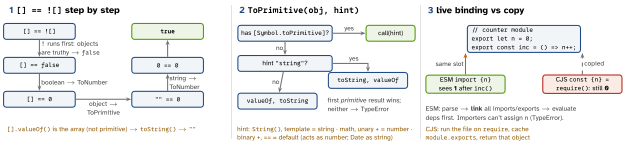
==vs===vsObject.is? — coerce · strict · strict + NaN, ±0.- Why is
[] == ![]true? — drawing 1. - ESM vs CJS? — static + live + async-capable vs runtime + copied + sync.