javascript · memo
In one line: Scope is lexical — fixed by where code is written: every function
keeps a hidden [[Environment]] pointer to the environment it was created in, and a
closure is that pointer keeping variables (not values) alive. this is the
opposite — dynamic, decided by how the function is called (except arrows).
Download PDF Print view LaTeX source
How it works — contexts and hoisting
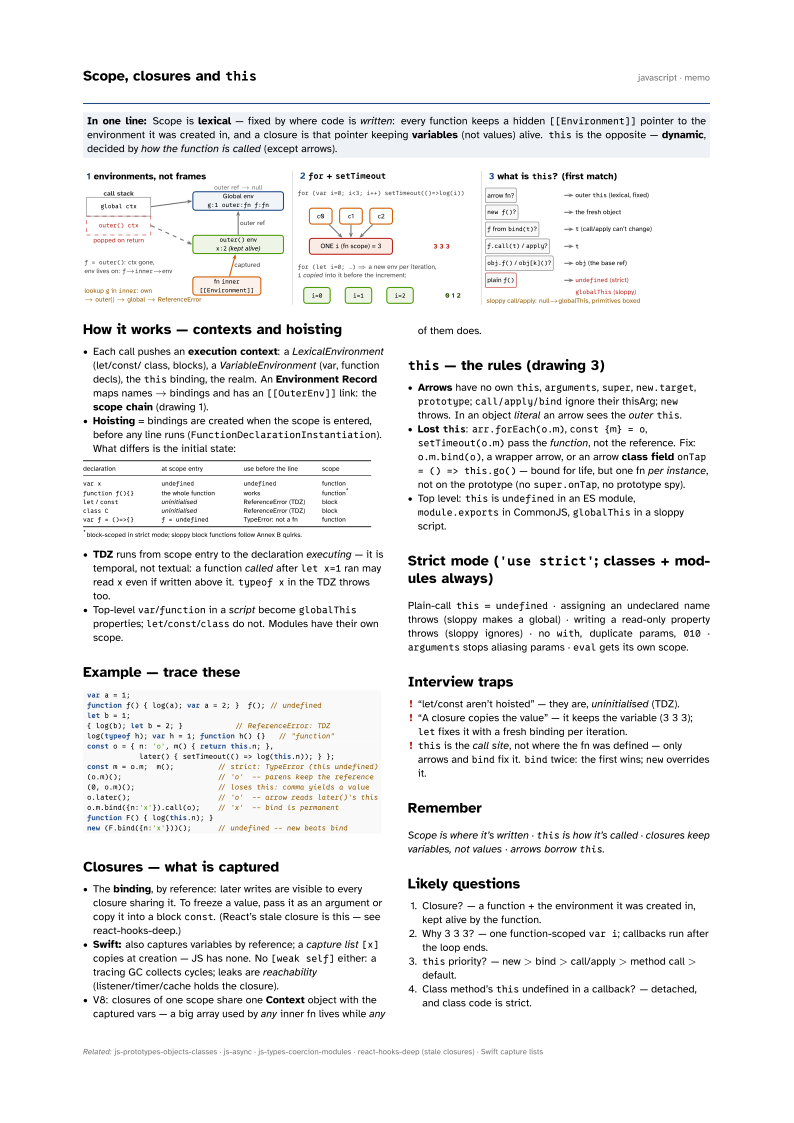
- Each call pushes an execution context: a LexicalEnvironment (let/const/ class, blocks), a VariableEnvironment (var, function decls), the
thisbinding, the realm. An Environment Record maps names → bindings and has an[[OuterEnv]]link: the scope chain (drawing 1). - Hoisting = bindings are created when the scope is entered, before any line runs (
FunctionDeclarationInstantiation). What differs is the initial state:
| declaration | at scope entry | use before the line | scope |
|---|---|---|---|
var x | undefined | undefined | function |
function f(){} | the whole function | works | function* |
let / const | uninitialised | ReferenceError (TDZ) | block |
class C | uninitialised | ReferenceError (TDZ) | block |
var f = ()=>{} | f = undefined | TypeError: not a fn | function |
[1pt] *block-scoped in strict mode; sloppy block functions follow Annex B quirks.
- TDZ runs from scope entry to the declaration executing — it is temporal, not textual: a function called after
let x=1ran may readxeven if written above it.typeof xin the TDZ throws too. - Top-level
var/functionin a script becomeglobalThisproperties;let/const/classdo not. Modules have their own scope.
Example — trace these
var a = 1;
function f() { log(a); var a = 2; }  f(); // undefined
let b = 1;
{ log(b); let b = 2; }            // ReferenceError: TDZ
log(typeof h); var h = 1; function h() {}   // "function"
const o = { n: 'o', m() { return this.n; },
            later() { setTimeout(() => log(this.n)); } };
const m = o.m;  m();          // strict: TypeError (this undefined)
(o.m)();                      // 'o'  -- parens keep the reference
(0, o.m)();                   // loses this: comma yields a value
o.later();                    // 'o'  -- arrow reads later()'s this
o.m.bind({n:'x'}).call(o);    // 'x'  -- bind is permanent
function F() { log(this.n); }
new (F.bind({n:'x'}))();      // undefined -- new beats bind
Closures — what is captured
- The binding, by reference: later writes are visible to every closure sharing it. To freeze a value, pass it as an argument or copy it into a block
const. (React’s stale closure is this — see react-hooks-deep.) - Swift: also captures variables by reference; a capture list
[x]copies at creation — JS has none. No[weak self]either: a tracing GC collects cycles; leaks are reachability (listener/timer/cache holds the closure). - V8: closures of one scope share one Context object with the captured vars — a big array used by any inner fn lives while any of them does.
this — the rules (drawing 3)
- Arrows have no own
this,arguments,super,new.target,prototype;call/apply/bindignore their thisArg;newthrows. In an object literal an arrow sees the outerthis. - Lost
this:arr.forEach(o.m),const {m} = o,setTimeout(o.m)pass the function, not the reference. Fix:o.m.bind(o), a wrapper arrow, or an arrow class fieldonTap = () => this.go()— bound for life, but one fn per instance, not on the prototype (nosuper.onTap, no prototype spy). - Top level:
thisisundefinedin an ES module,module.exportsin CommonJS,globalThisin a sloppy script.
Strict mode ('use strict'; classes + modules always)
Plain-call this = undefined · assigning an undeclared name throws (sloppy makes a global) · writing a read-only property throws (sloppy ignores) · no with, duplicate params, 010 · arguments stops aliasing params · eval gets its own scope.
Interview traps
- “let/const aren’t hoisted” — they are, uninitialised (TDZ).
- “A closure copies the value” — it keeps the variable (3 3 3);
letfixes it with a fresh binding per iteration. thisis the call site, not where the fn was defined — only arrows andbindfix it.bindtwice: the first wins;newoverrides it.
Remember
Scope is where it’s written · this is how it’s called · closures keep variables,
not values · arrows borrow this.
Likely questions
- Closure? — a function + the environment it was created in, kept alive by the function.
- Why 3 3 3? — one function-scoped
var i; callbacks run after the loop ends. thispriority? — new > bind > call/apply > method call > default.- Class method’s
thisundefined in a callback? — detached, and class code is strict.