javascript · memo
In one line: Functions are values that close over their scope, so these idioms are closures with
a shape: currying turns f(a,b,c) into f(a)(b)(c); partial
application fixes some arguments now (bind); an IIFE makes a private scope
and runs it once; a tagged template is a call on a template’s pieces; a
generator is a pausable function that yields values on demand.
Download PDF Print view LaTeX source
How it works
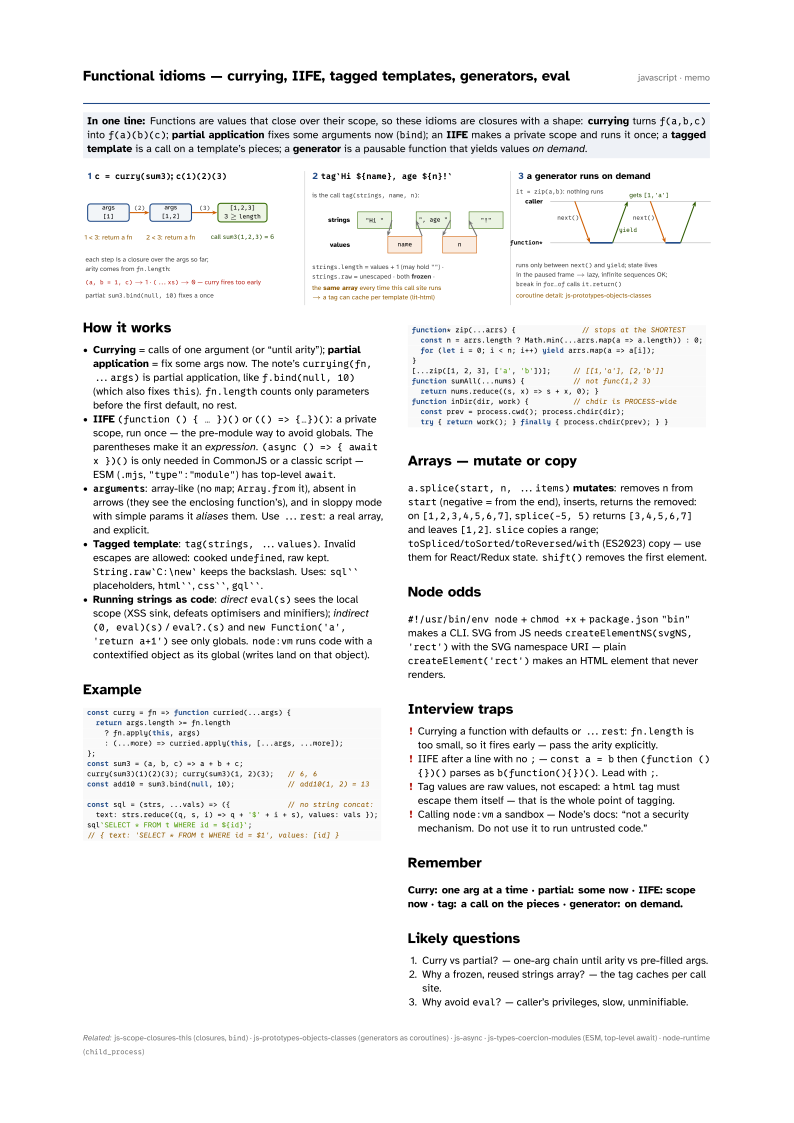
- Currying = calls of one argument (or “until arity”); partial
application = fix some args now. The note’s
currying(fn, ...args)is partial application, likef.bind(null, 10)(which also fixesthis).fn.lengthcounts only parameters before the first default, no rest. - IIFE
(function () { … })()or(() => {…})(): a private scope, run once — the pre-module way to avoid globals. The parentheses make it an expression.(async () => { await x })()is only needed in CommonJS or a classic script — ESM (.mjs,"type":"module") has top-levelawait. arguments: array-like (nomap;Array.fromit), absent in arrows (they see the enclosing function’s), and in sloppy mode with simple params it aliases them. Use...rest: a real array, and explicit.- Tagged template:
tag(strings, ...values). Invalid escapes are allowed: cookedundefined, raw kept.String.raw`C:\ new`keeps the backslash. Uses:sql``placeholders,html``,css``,gql``. - Running strings as code: direct
eval(s)sees the local scope (XSS sink, defeats optimisers and minifiers); indirect(0, eval)(s)/eval?.(s)andnew Function('a', 'return a+1')see only globals.node:vmruns code with a contextified object as its global (writes land on that object).
Example
const curry = fn => function curried(...args) {
  return args.length >= fn.length
    ? fn.apply(this, args)
    : (...more) => curried.apply(this, [...args, ...more]);
};
const sum3 = (a, b, c) => a + b + c;
curry(sum3)(1)(2)(3); curry(sum3)(1, 2)(3);   // 6, 6
const add10 = sum3.bind(null, 10);            // add10(1, 2) = 13

const sql = (strs, ...vals) => ({             // no string concat:
  text: strs.reduce((q, s, i) => q + '$' + i + s), values: vals });
sql`SELECT * FROM t WHERE id = ${id}`;
// { text: 'SELECT * FROM t WHERE id = $1', values: [id] }
function* zip(...arrs) { // stops at the SHORTEST
const n = arrs.length ? Math.min(...arrs.map(a => a.length)) : 0;
for (let i = 0; i < n; i++) yield arrs.map(a => a[i]);
}
[...zip([1, 2, 3], ['a', 'b'])]; // [[1,'a'], [2,'b']]
function sumAll(...nums) { // not func(1,2 3)
return nums.reduce((s, x) => s + x, 0); }
function inDir(dir, work) { // chdir is PROCESS-wide
const prev = process.cwd(); process.chdir(dir);
try { return work(); } finally { process.chdir(prev); } }Arrays — mutate or copy
a.splice(start, n, ...items) mutates: removes n from start (negative = from the end), inserts, returns the removed: on [1,2,3,4,5,6,7], splice(-5, 5) returns [3,4,5,6,7] and leaves [1,2]. slice copies a range; toSpliced/toSorted/toReversed/with (ES2023) copy — use them for React/Redux state. shift() removes the first element.
Node odds
#!/usr/bin/env node + chmod +x + package.json "bin" makes a CLI. SVG from JS needs createElementNS(svgNS, 'rect') with the SVG namespace URI — plain createElement('rect') makes an HTML element that never renders.
Interview traps
- Currying a function with defaults or
...rest:fn.lengthis too small, so it fires early — pass the arity explicitly. - IIFE after a line with no
;—const a = bthen(function () {})()parses asb(function(){})(). Lead with;. - Tag values are raw values, not escaped: a
htmltag must escape them itself — that is the whole point of tagging. - Calling
node:vma sandbox — Node’s docs: “not a security mechanism. Do not use it to run untrusted code.”
Remember
Curry: one arg at a time · partial: some now · IIFE: scope now · tag: a call on the pieces · generator: on demand.
Likely questions
- Curry vs partial? — one-arg chain until arity vs pre-filled args.
- Why a frozen, reused strings array? — the tag caches per call site.
- Why avoid
eval? — caller’s privileges, slow, unminifiable.