iot · memo
In one line: CoAP (RFC 7252) is REST over UDP: GET/POST/PUT/DELETE and
HTTP-like codes in a 4-byte binary header, reliability by confirmable
messages with exponential backoff, push by Observe, big bodies by
block-wise, security by DTLS or OSCORE. LwM2M (OMA
SpecWorks) is device management on top of CoAP: a standard
object/instance/resource tree (/3/0/3 = firmware version) plus
bootstrap, registration, management and reporting interfaces.
Download PDF Print view LaTeX source

CoAP — how it works
- UDP port 5683, DTLS 5684; TCP/TLS/WebSocket binding exists (RFC 8323) but UDP is the design point: no connection state, no head-of-line blocking.
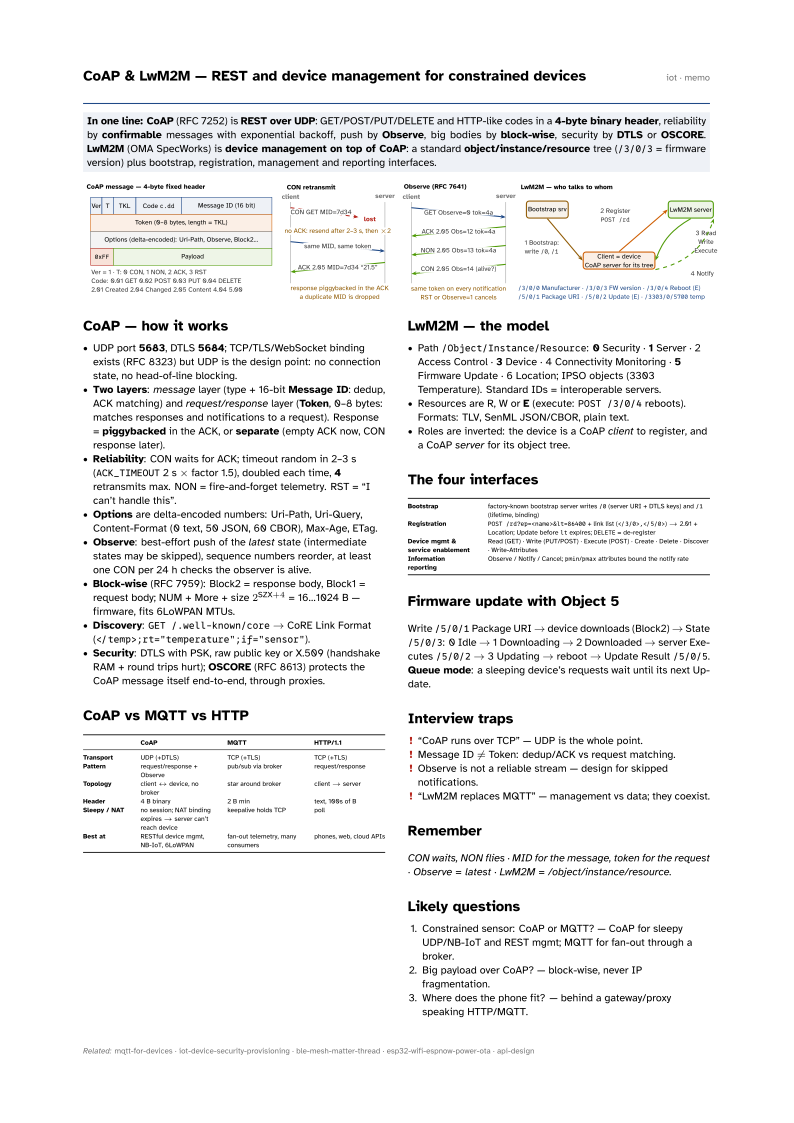
- Two layers: message layer (type + 16-bit Message ID: dedup, ACK matching) and request/response layer (Token, 0–8 bytes: matches responses and notifications to a request). Response = piggybacked in the ACK, or separate (empty ACK now, CON response later).
- Reliability: CON waits for ACK; timeout random in 2–3 s (
ACK_TIMEOUT2 s × factor 1.5), doubled each time, 4 retransmits max. NON = fire-and-forget telemetry. RST = “I can’t handle this”. - Options are delta-encoded numbers: Uri-Path, Uri-Query, Content-Format (0 text, 50 JSON, 60 CBOR), Max-Age, ETag.
- Observe: best-effort push of the latest state (intermediate states may be skipped), sequence numbers reorder, at least one CON per 24 h checks the observer is alive.
- Block-wise (RFC 7959): Block2 = response body, Block1 = request body; NUM + More + size 2SZX+4 = 16…1024 B — firmware, fits 6LoWPAN MTUs.
- Discovery:
GET /.well-known/core→ CoRE Link Format (</temp>;rt="temperature";if="sensor"). - Security: DTLS with PSK, raw public key or X.509 (handshake RAM + round trips hurt); OSCORE (RFC 8613) protects the CoAP message itself end-to-end, through proxies.
CoAP vs MQTT vs HTTP
| CoAP | MQTT | HTTP/1.1 | |
|---|---|---|---|
| Transport | UDP (+DTLS) | TCP (+TLS) | TCP (+TLS) |
| Pattern | request/response + Observe | pub/sub via broker | request/response |
| Topology | client ↔ device, no broker | star around broker | client → server |
| Header | 4 B binary | 2 B min | text, 100s of B |
| Sleepy / NAT | no session; NAT binding expires → server can’t reach device | keepalive holds TCP | poll |
| Best at | RESTful device mgmt, NB-IoT, 6LoWPAN | fan-out telemetry, many consumers | phones, web, cloud APIs |
LwM2M — the model
- Path
/Object/Instance/Resource: 0 Security · 1 Server · 2 Access Control · 3 Device · 4 Connectivity Monitoring · 5 Firmware Update · 6 Location; IPSO objects (3303 Temperature). Standard IDs = interoperable servers. - Resources are R, W or E (execute:
POST /3/0/4reboots). Formats: TLV, SenML JSON/CBOR, plain text. - Roles are inverted: the device is a CoAP client to register, and a CoAP server for its object tree.
The four interfaces
| Bootstrap | factory-known bootstrap server writes /0 (server URI + DTLS keys)
and /1 (lifetime, binding) |
| Registration | POST /rd?ep=<name><=86400 + link list
(</3/0>,</5/0>) → 2.01 + Location; Update before lt expires;
DELETE = de-register |
| Device mgmt & service enablement | Read (GET) · Write (PUT/POST) · Execute (POST) · Create · Delete · Discover · Write-Attributes |
| Information reporting | Observe / Notify / Cancel; pmin/pmax attributes
bound the notify rate |
Firmware update with Object 5
Write /5/0/1 Package URI → device downloads (Block2) → State /5/0/3: 0 Idle → 1 Downloading → 2 Downloaded → server Executes /5/0/2 → 3 Updating → reboot → Update Result /5/0/5. Queue mode: a sleeping device’s requests wait until its next Update.
Interview traps
- “CoAP runs over TCP” — UDP is the whole point.
- Message ID ≠ Token: dedup/ACK vs request matching.
- Observe is not a reliable stream — design for skipped notifications.
- “LwM2M replaces MQTT” — management vs data; they coexist.
Remember
CON waits, NON flies · MID for the message, token for the request · Observe = latest · LwM2M = /object/instance/resource.
Likely questions
- Constrained sensor: CoAP or MQTT? — CoAP for sleepy UDP/NB-IoT and REST mgmt; MQTT for fan-out through a broker.
- Big payload over CoAP? — block-wise, never IP fragmentation.
- Where does the phone fit? — behind a gateway/proxy speaking HTTP/MQTT.