interview · memo
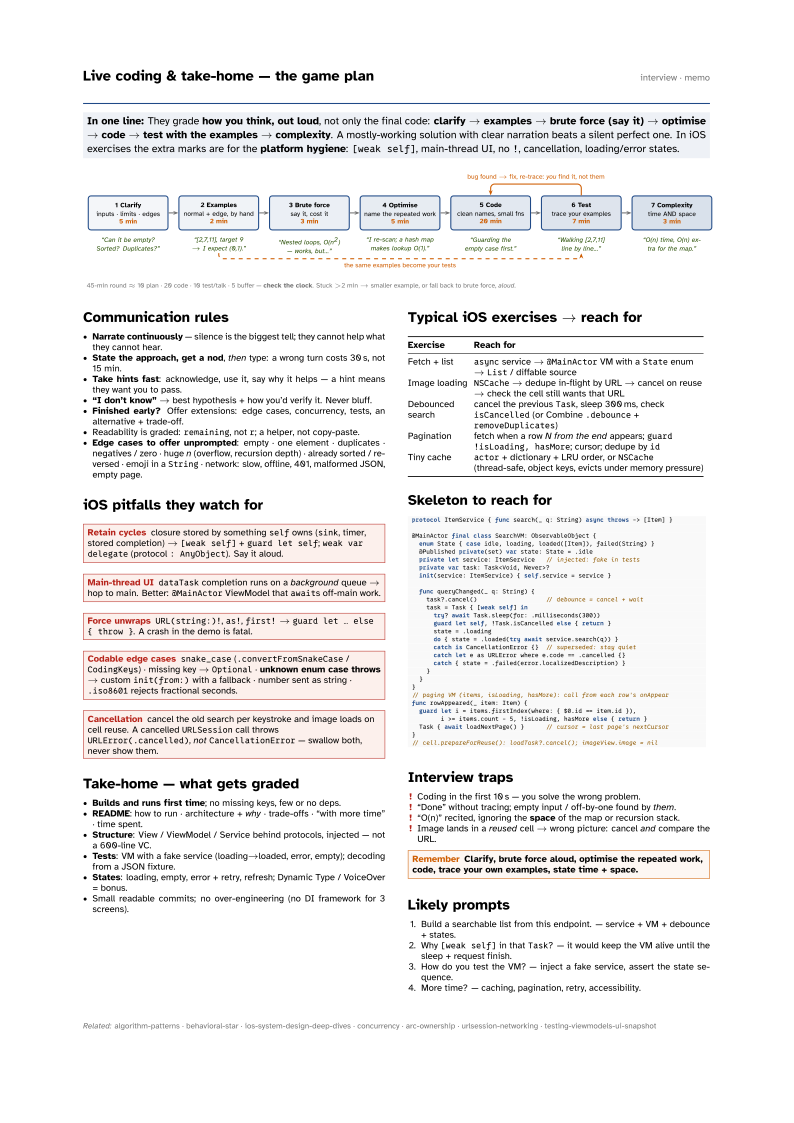
In one line: They grade how you think, out loud, not only the final code:
clarify → examples → brute force (say it) → optimise → code → test with the examples → complexity.
A mostly-working solution with clear narration beats a silent perfect one. In iOS exercises the
extra marks are for the platform hygiene: [weak self], main-thread UI, no !, cancellation, loading/error states.
Download PDF Print view LaTeX source

Communication rules
- Narrate continuously — silence is the biggest tell; they cannot help what they cannot hear.
- State the approach, get a nod, then type: a wrong turn costs 30 s, not 15 min.
- Take hints fast: acknowledge, use it, say why it helps — a hint means they want you to pass.
- “I don’t know” → best hypothesis + how you’d verify it. Never bluff.
- Finished early? Offer extensions: edge cases, concurrency, tests, an alternative + trade-off.
- Readability is graded:
remaining, notr; a helper, not copy-paste. - Edge cases to offer unprompted: empty · one element · duplicates · negatives / zero · huge n (overflow, recursion depth) · already sorted / reversed · emoji in a
String· network: slow, offline, 401, malformed JSON, empty page.
iOS pitfalls they watch for
Retain cycles closure stored by something self owns (sink, timer, stored completion) → [weak self] + guard let self; weak var delegate (protocol : AnyObject). Say it aloud.
Main-thread UI dataTask completion runs on a background queue → hop to main. Better: @MainActor ViewModel that awaits off-main work.
Force unwraps URL(string:)!, as!, first! → guard let … else { throw }. A crash in the demo is fatal.
Codable edge cases snake_case (.convertFromSnakeCase / CodingKeys) · missing key → Optional · unknown enum case throws → custom init(from:) with a fallback · number sent as string · .iso8601 rejects fractional seconds.
Cancellation cancel the old search per keystroke and image loads on cell reuse. A cancelled URLSession call throws URLError(.cancelled), not CancellationError — swallow both, never show them.
Take-home — what gets graded
- Builds and runs first time; no missing keys, few or no deps.
- README: how to run · architecture + why · trade-offs · “with more time” · time spent.
- Structure: View / ViewModel / Service behind protocols, injected — not a 600-line VC.
- Tests: VM with a fake service (loading→loaded, error, empty); decoding from a JSON fixture.
- States: loading, empty, error + retry, refresh; Dynamic Type / VoiceOver = bonus.
- Small readable commits; no over-engineering (no DI framework for 3 screens).
Typical iOS exercises → reach for
| Exercise | Reach for |
|---|---|
| Fetch + list | async service → @MainActor VM with a State enum → List / diffable source |
| Image loading | NSCache → dedupe in-flight by URL → cancel on reuse → check the cell still wants that URL |
| Debounced search | cancel the previous Task, sleep 300 ms, check isCancelled (or Combine .debounce + removeDuplicates) |
| Pagination | fetch when a row N from the end appears; guard !isLoading, hasMore; cursor; dedupe by id |
| Tiny cache | actor + dictionary + LRU order, or NSCache (thread-safe, object keys, evicts under memory pressure) |
Skeleton to reach for
protocol ItemService { func search(_ q: String) async throws -> [Item] }

@MainActor final class SearchVM: ObservableObject {
  enum State { case idle, loading, loaded([Item]), failed(String) }
  @Published private(set) var state: State = .idle
  private let service: ItemService   // injected: fake in tests
  private var task: Task<Void, Never>?
  init(service: ItemService) { self.service = service }

  func queryChanged(_ q: String) {
    task?.cancel()                   // debounce = cancel + wait
    task = Task { [weak self] in
      try? await Task.sleep(for: .milliseconds(300))
      guard let self, !Task.isCancelled else { return }
      state = .loading
      do { state = .loaded(try await service.search(q)) }
      catch is CancellationError {}  // superseded: stay quiet
      catch let e as URLError where e.code == .cancelled {}
      catch { state = .failed(error.localizedDescription) }
    }
  }
}
// paging VM (items, isLoading, hasMore): call from each row's onAppear
func rowAppeared(_ item: Item) {
  guard let i = items.firstIndex(where: { $0.id == item.id }),
        i >= items.count - 5, !isLoading, hasMore else { return }
  Task { await loadNextPage() }      // cursor = last page's nextCursor
}
// cell.prepareForReuse(): loadTask?.cancel(); imageView.image = nil
Interview traps
- Coding in the first 10 s — you solve the wrong problem.
- “Done” without tracing; empty input / off-by-one found by them.
- “O(n)” recited, ignoring the space of the map or recursion stack.
- Image lands in a reused cell → wrong picture: cancel and compare the URL.
Remember Clarify, brute force aloud, optimise the repeated work, code, trace your own examples, state time + space.
Likely prompts
- Build a searchable list from this endpoint. — service + VM + debounce + states.
- Why
[weak self]in thatTask? — it would keep the VM alive until the sleep + request finish. - How do you test the VM? — inject a fake service, assert the state sequence.
- More time? — caching, pagination, retry, accessibility.