interview · memo
In one line: After the boxes-and-arrows, the interviewer picks one box and asks “how exactly?”. Score by naming the mechanism: the cache key and eviction, the reconnect state machine, the idempotency key, the ordering authority, the conflict policy and how you detect a conflict, the cursor, the flag’s default when nothing was fetched, and what leaves the device privately.
Download PDF Print view LaTeX source
1 · Image cache
Tiers: memory NSCache of decoded, downsampled images → disk (bytes in Caches/) → network. Hits are hoisted up.
Key: URL + target pixel size (+ transform); disk filename = SHA-256(URL) — never hashValue (seeded per run).
Eviction: totalCostLimit with cost = w·h·4 bytes; NSCache also purges under memory pressure but is not strict LRU. Disk: byte cap + age, LRU sweep off-main; never Documents/ (backed up).
Downsample with ImageIO to points × scale: a 4000×3000 photo is 48 MB decoded, whatever its JPEG size.
Reuse: cancel in prepareForReuse and check the cell still wants that URL. Dedupe in-flight by key; cancel the download only when its last observer leaves. Cap decode concurrency; prefetch at low priority, cancellable.
trap: URLCache alone caches encoded bytes, not the decoded bitmap — decode still hits every scroll.
actor ImageLoader {
  private let memory = NSCache<NSString, UIImage>()
  private var inflight: [String: Task<UIImage, Error>] = [:]
  func image(_ url: URL, px: Int) async throws -> UIImage {
    let key = "\(url.absoluteString)@\(px)"
    if let hit = memory.object(forKey: key as NSString) { return hit }
    if let running = inflight[key] { return try await running.value }
    let task = Task { try await diskOrNetwork(url, downsampleTo: px) }
    inflight[key] = task; defer { inflight[key] = nil }
    let img = try await task.value
    memory.setObject(img, forKey: key as NSString, cost: px * px * 4)
    return img
  }
}
2 · Chat / realtime
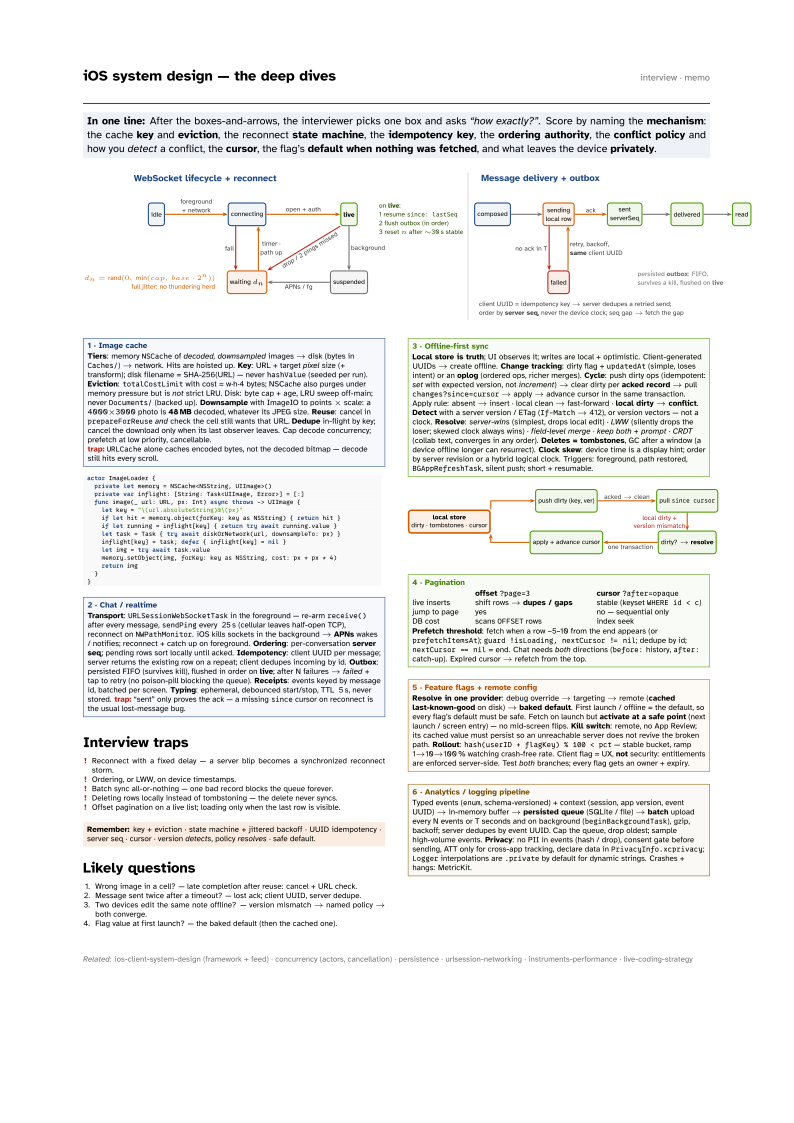
Transport: URLSessionWebSocketTask in the foreground — re-arm receive() after every message, sendPing every 25 s (cellular leaves half-open TCP), reconnect on NWPathMonitor. iOS kills sockets in the background → APNs wakes / notifies; reconnect + catch up on foreground.
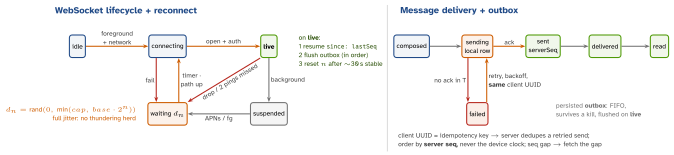
Ordering: per-conversation server seq; pending rows sort locally until acked. Idempotency: client UUID per message; server returns the existing row on a repeat; client dedupes incoming by id.
Outbox: persisted FIFO (survives kill), flushed in order on live; after N failures → failed + tap to retry (no poison-pill blocking the queue).
Receipts: events keyed by message id, batched per screen. Typing: ephemeral, debounced start/stop, TTL 5 s, never stored.
trap: “sent” only proves the ack — a missing since cursor on reconnect is the usual lost-message bug.
Interview traps
- Reconnect with a fixed delay — a server blip becomes a synchronized reconnect storm.
- Ordering, or LWW, on device timestamps.
- Batch sync all-or-nothing — one bad record blocks the queue forever.
- Deleting rows locally instead of tombstoning — the delete never syncs.
- Offset pagination on a live list; loading only when the last row is visible.
Remember: key + eviction · state machine + jittered backoff · UUID idempotency · server seq · cursor · version detects, policy resolves · safe default.
Likely questions
- Wrong image in a cell? — late completion after reuse: cancel + URL check.
- Message sent twice after a timeout? — lost ack; client UUID, server dedupe.
- Two devices edit the same note offline? — version mismatch → named policy → both converge.
- Flag value at first launch? — the baked default (then the cached one).
3 · Offline-first sync
Local store is truth; UI observes it; writes are local + optimistic. Client-generated UUIDs → create offline.
Change tracking: dirty flag + updatedAt (simple, loses intent) or an oplog (ordered ops, richer merges).
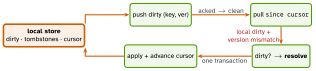
Cycle: push dirty ops (idempotent: set with expected version, not increment) → clear dirty per acked record → pull changes?since=cursor → apply → advance cursor in the same transaction.
Apply rule: absent → insert · local clean → fast-forward · local dirty → conflict.
Detect with a server version / ETag (If-Match → 412), or version vectors — not a clock.
Resolve: server-wins (simplest, drops local edit) · LWW (silently drops the loser; skewed clock always wins) · field-level merge · keep both + prompt · CRDT (collab text, converges in any order).
Deletes = tombstones, GC after a window (a device offline longer can resurrect).
Clock skew: device time is a display hint; order by server revision or a hybrid logical clock.
Triggers: foreground, path restored, BGAppRefreshTask, silent push; short + resumable.
4 · Pagination
Prefetch threshold: fetch when a row ~5–10 from the end appears (or offset ?page=3cursor ?after=opaquelive inserts shift rows → dupes / gaps stable (keyset WHERE id < c)jump to page yes no — sequential only DB cost scans OFFSET rowsindex seek prefetchItemsAt); guard !isLoading, nextCursor != nil; dedupe by id; nextCursor == nil = end. Chat needs both directions (before: history, after: catch-up). Expired cursor → refetch from the top.
5 · Feature flags + remote config
Resolve in one provider: debug override → targeting → remote (cached last-known-good on disk) → baked default. First launch / offline = the default, so every flag’s default must be safe. Fetch on launch but activate at a safe point (next launch / screen entry) — no mid-screen flips.
Kill switch: remote, no App Review; its cached value must persist so an unreachable server does not revive the broken path.
Rollout: hash(userID + flagKey) % 100 < pct — stable bucket, ramp 1→10→100 % watching crash-free rate.
Client flag = UX, not security: entitlements are enforced server-side. Test both branches; every flag gets an owner + expiry.
6 · Analytics / logging pipeline
Typed events (enum, schema-versioned) + context (session, app version, event UUID) → in-memory buffer → persisted queue (SQLite / file) → batch upload every N events or T seconds and on background (beginBackgroundTask), gzip, backoff; server dedupes by event UUID. Cap the queue, drop oldest; sample high-volume events.
Privacy: no PII in events (hash / drop), consent gate before sending, ATT only for cross-app tracking, declare data in PrivacyInfo.xcprivacy; Logger interpolations are .private by default for dynamic strings. Crashes + hangs: MetricKit.