interview · memo
In one line: Every behavioural answer is a ∼2-minute story: Situation (context, 1–2 sentences) · Task (your responsibility) · Action (what I did — the bulk) · Result (a number or concrete outcome) · then the reflection (what I learned / would do differently). They are not scoring the project — they are scoring you: ownership, influence, judgement, growth.
Download PDF Print view LaTeX source
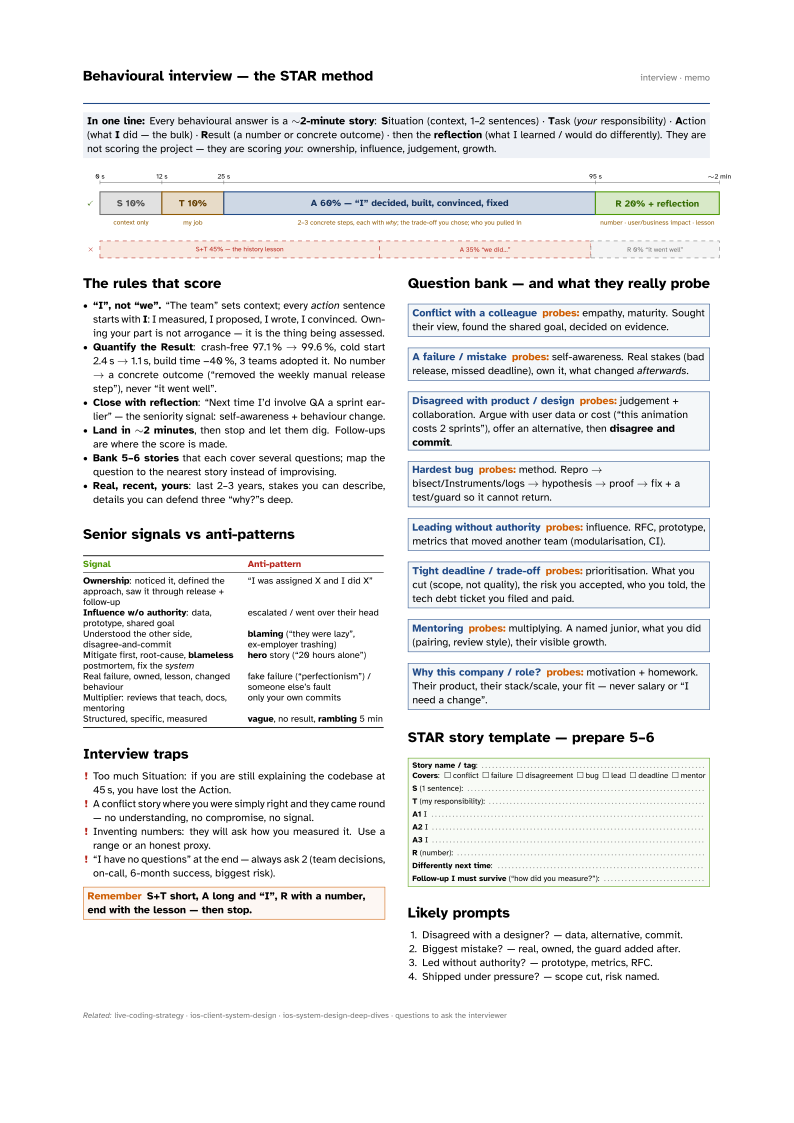

The rules that score
- “I”, not “we”. “The team” sets context; every action sentence starts with I: I measured, I proposed, I wrote, I convinced. Owning your part is not arrogance — it is the thing being assessed.
- Quantify the Result: crash-free 97.1 % → 99.6 %, cold start 2.4 s → 1.1 s, build time −40 %, 3 teams adopted it. No number → a concrete outcome (“removed the weekly manual release step”), never “it went well”.
- Close with reflection: “Next time I’d involve QA a sprint earlier” — the seniority signal: self-awareness + behaviour change.
- Land in ∼2 minutes, then stop and let them dig. Follow-ups are where the score is made.
- Bank 5–6 stories that each cover several questions; map the question to the nearest story instead of improvising.
- Real, recent, yours: last 2–3 years, stakes you can describe, details you can defend three “why?”s deep.
Senior signals vs anti-patterns
| Signal | Anti-pattern |
|---|---|
| Ownership: noticed it, defined the approach, saw it through release + follow-up | “I was assigned X and I did X” |
| Influence w/o authority: data, prototype, shared goal | escalated / went over their head |
| Understood the other side, disagree-and-commit | blaming (“they were lazy”, ex-employer trashing) |
| Mitigate first, root-cause, blameless postmortem, fix the system | hero story (“20 hours alone”) |
| Real failure, owned, lesson, changed behaviour | fake failure (“perfectionism”) / someone else’s fault |
| Multiplier: reviews that teach, docs, mentoring | only your own commits |
| Structured, specific, measured | vague, no result, rambling 5 min |
Interview traps
- Too much Situation: if you are still explaining the codebase at 45 s, you have lost the Action.
- A conflict story where you were simply right and they came round — no understanding, no compromise, no signal.
- Inventing numbers: they will ask how you measured it. Use a range or an honest proxy.
- “I have no questions” at the end — always ask 2 (team decisions, on-call, 6-month success, biggest risk).
Remember S+T short, A long and “I”, R with a number, end with the lesson — then stop.
Question bank — and what they really probe
Conflict with a colleague probes: empathy, maturity. Sought their view, found the shared goal, decided on evidence.
A failure / mistake probes: self-awareness. Real stakes (bad release, missed deadline), own it, what changed afterwards.
Disagreed with product / design probes: judgement + collaboration. Argue with user data or cost (“this animation costs 2 sprints”), offer an alternative, then disagree and commit.
Hardest bug probes: method. Repro → bisect/Instruments/logs → hypothesis → proof → fix + a test/guard so it cannot return.
Leading without authority probes: influence. RFC, prototype, metrics that moved another team (modularisation, CI).
Tight deadline / trade-off probes: prioritisation. What you cut (scope, not quality), the risk you accepted, who you told, the tech debt ticket you filed and paid.
Mentoring probes: multiplying. A named junior, what you did (pairing, review style), their visible growth.
Why this company / role? probes: motivation + homework. Their product, their stack/scale, your fit — never salary or “I need a change”.
STAR story template — prepare 5–6
Story name / tag: Covers: □ conflict □ failure □ disagreement □ bug □ lead □ deadline □ mentor S (1 sentence): T (my responsibility): A1 I A2 I A3 I R (number): Differently next time: Follow-up I must survive (“how did you measure?”):
Likely prompts
- Disagreed with a designer? — data, alternative, commit.
- Biggest mistake? — real, owned, the guard added after.
- Led without authority? — prototype, metrics, RFC.
- Shipped under pressure? — scope cut, risk named.