cs · memo
In one line: A hash maps arbitrary input to a fixed-size value. Table hashes want speed + uniformity and a secret seed against flooding (Swift: SipHash, reseeded per process); cryptographic hashes want one-wayness and collision resistance (SHA-256); password hashes want to be slow and memory-hard; a MAC needs a key. Choosing the wrong family is the classic mistake.
Download PDF Print view LaTeX source

What makes a hash good
- Deterministic (within its seed), uniform (keys spread evenly over buckets), avalanche (flip 1 input bit → ∼half the output bits flip, so near-identical keys don’t cluster), fast (O(key length)).
- Table hashes: FNV, Murmur, xxHash (fast, unkeyed → floodable); SipHash (Aumasson & Bernstein 2012) is a fast keyed PRF built to stop flooding. Swift’s
Hasheruses SipHash-1-3, keyed by a random per-process seed (SWIFT_DETERMINISTIC_HASHING=1to pin it in tests). - HashDoS (28C3, 2011): an attacker who knows an unkeyed hash posts thousands of keys that collide → every insert walks one chain → O(n2) CPU from one request. The secret seed makes the collision set unpredictable. Cost:
hashValueandSetorder change every launch.
Collisions — normal, then resolved
- Birthday bound: with m possible values, a collision is likely after ∼√(m) items: P ≈1 - e-n2/2m. 23 people → 50 %; a 64-bit hash → ∼232 (4 billion) items; UUIDv4 (122 random bits) → ∼2.7×10¹⁸. SHA-256 collision work = 2128, not 2256.
- Chaining (list per bucket; Java
HashMapturns a chain of ≥8 into a red-black tree). Open addressing: linear probing (cache-friendly, primary clustering), quadratic, double hashing, Robin Hood (steal the slot from a key nearer its home — evens probe lengths), cuckoo (2 tables, O(1) worst-case lookup). Deletion needs tombstones or backward shift. - Rehash: at load α ≈ 0.75 (Swift: 3/4) double and re-insert all — O(n) once, O(1) amortised, a visible latency spike. Redis rehashes incrementally (two tables, move a few buckets per op).
- Consistent hashing:
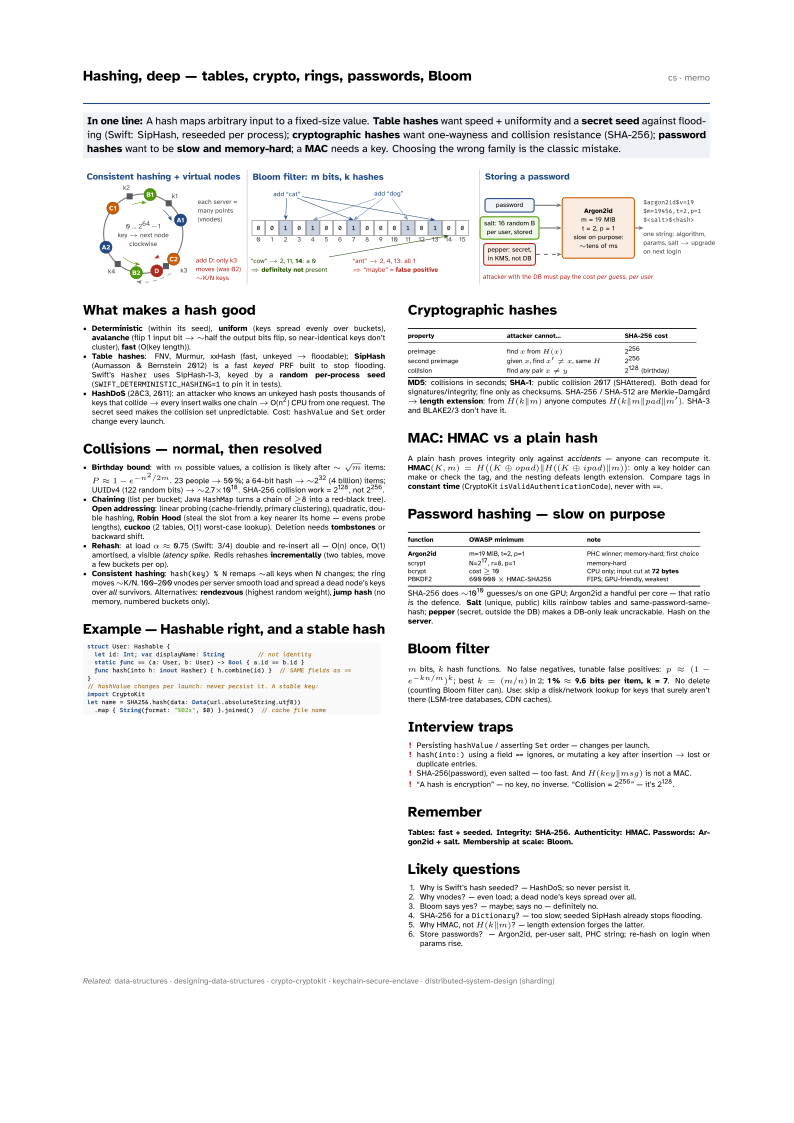
hash(key) % Nremaps ∼all keys when N changes; the ring moves ∼K/N. 100–200 vnodes per server smooth load and spread a dead node’s keys over all survivors. Alternatives: rendezvous (highest random weight), jump hash (no memory, numbered buckets only).
Example — Hashable right, and a stable hash
struct User: Hashable {
  let id: Int; var displayName: String         // not identity
  static func == (a: User, b: User) -> Bool { a.id == b.id }
  func hash(into h: inout Hasher) { h.combine(id) }  // SAME fields as ==
}
// hashValue changes per launch: never persist it. A stable key:
import CryptoKit
let name = SHA256.hash(data: Data(url.absoluteString.utf8))
  .map { String(format: "%02x", $0) }.joined()  // cache file name
Cryptographic hashes
| property | attacker cannot… | SHA-256 cost |
|---|---|---|
| preimage | find x from H(x) | 2256 |
| second preimage | given x, find x’ ≠x, same H | 2256 |
| collision | find any pair x ≠y | 2128 (birthday) |
MAC: HMAC vs a plain hash
A plain hash proves integrity only against accidents — anyone can recompute it. HMAC(K,m) = H((K ⊕opad) ‖H((K ⊕ipad)
‖m)): only a key holder can make or check the tag, and the nesting defeats length extension. Compare tags in constant time (CryptoKit isValidAuthenticationCode), never with ==.
Password hashing — slow on purpose
| function | OWASP minimum | note |
|---|---|---|
| Argon2id | m=19 MiB, t=2, p=1 | PHC winner; memory-hard; first choice |
| scrypt | N=217, r=8, p=1 | memory-hard |
| bcrypt | cost ≥ 10 | CPU only; input cut at 72 bytes |
| PBKDF2 | 600 000 × HMAC-SHA256 | FIPS; GPU-friendly, weakest |
Bloom filter
m bits, k hash functions. No false negatives, tunable false positives: p ≈(1-e-kn/m)k; best k = (m/n)ln2; 1 % ≈ 9.6 bits per item, k = 7. No delete (counting Bloom filter can). Use: skip a disk/network lookup for keys that surely aren’t there (LSM-tree databases, CDN caches).
Interview traps
- Persisting
hashValue/ assertingSetorder — changes per launch. hash(into:)using a field==ignores, or mutating a key after insertion → lost or duplicate entries.- SHA-256(password), even salted — too fast. And H(key ‖msg) is not a MAC.
- “A hash is encryption” — no key, no inverse. “Collision = 2256” — it’s 2128.
Remember
Tables: fast + seeded. Integrity: SHA-256. Authenticity: HMAC. Passwords: Argon2id + salt. Membership at scale: Bloom.
Likely questions
- Why is Swift’s hash seeded? — HashDoS; so never persist it.
- Why vnodes? — even load; a dead node’s keys spread over all.
- Bloom says yes? — maybe; says no — definitely no.
- SHA-256 for a
Dictionary? — too slow; seeded SipHash already stops flooding. - Why HMAC, not H(k ‖m)? — length extension forges the latter.
- Store passwords? — Argon2id, per-user salt, PHC string; re-hash on login when params rise.