cs · memo
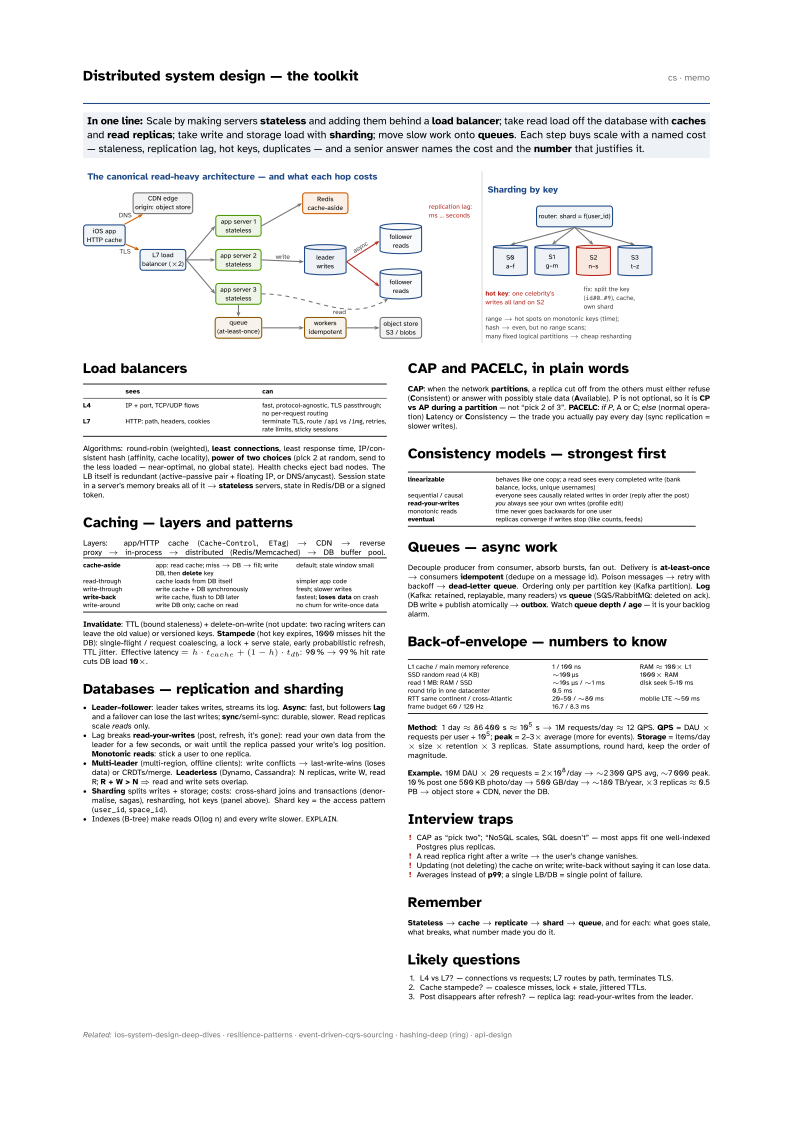
In one line: Scale by making servers stateless and adding them behind a load balancer; take read load off the database with caches and read replicas; take write and storage load with sharding; move slow work onto queues. Each step buys scale with a named cost — staleness, replication lag, hot keys, duplicates — and a senior answer names the cost and the number that justifies it.
Download PDF Print view LaTeX source
Load balancers
| sees | can | |
|---|---|---|
| L4 | IP + port, TCP/UDP flows | fast, protocol-agnostic, TLS passthrough; no per-request routing |
| L7 | HTTP: path, headers, cookies | terminate TLS, route /api vs /img, retries, rate limits, sticky sessions |
Algorithms: round-robin (weighted), least connections, least response time, IP/consistent hash (affinity, cache locality), power of two choices (pick 2 at random, send to the less loaded — near-optimal, no global state). Health checks eject bad nodes. The LB itself is redundant (active–passive pair + floating IP, or DNS/anycast). Session state in a server’s memory breaks all of it → stateless servers, state in Redis/DB or a signed token.
Caching — layers and patterns
Layers: app/HTTP cache (Cache-Control, ETag) → CDN → reverse proxy → in-process → distributed (Redis/Memcached) → DB buffer pool.
| cache-aside | app: read cache; miss → DB → fill; write DB, then delete key | default; stale window small |
| read-through | cache loads from DB itself | simpler app code |
| write-through | write cache + DB synchronously | fresh; slower writes |
| write-back | write cache, flush to DB later | fastest; loses data on crash |
| write-around | write DB only; cache on read | no churn for write-once data |
Invalidate: TTL (bound staleness) + delete-on-write (not update: two racing writers can leave the old value) or versioned keys. Stampede (hot key expires, 1000 misses hit the DB): single-flight / request coalescing, a lock + serve stale, early probabilistic refresh, TTL jitter. Effective latency = h ·tcache + (1-h) ·tdb: 90 % → 99 % hit rate cuts DB load 10×.
Databases — replication and sharding
- Leader–follower: leader takes writes, streams its log. Async: fast, but followers lag and a failover can lose the last writes; sync/semi-sync: durable, slower. Read replicas scale reads only.
- Lag breaks read-your-writes (post, refresh, it’s gone): read your own data from the leader for a few seconds, or wait until the replica passed your write’s log position. Monotonic reads: stick a user to one replica.
- Multi-leader (multi-region, offline clients): write conflicts → last-write-wins (loses data) or CRDTs/merge. Leaderless (Dynamo, Cassandra): N replicas, write W, read R; R + W > N ⇒ read and write sets overlap.
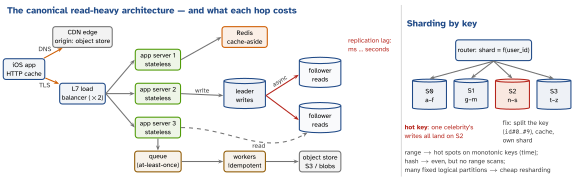
- Sharding splits writes + storage; costs: cross-shard joins and transactions (denormalise, sagas), resharding, hot keys (panel above). Shard key = the access pattern (
user_id,space_id). - Indexes (B-tree) make reads O(log n) and every write slower.
EXPLAIN.
CAP and PACELC, in plain words
CAP: when the network partitions, a replica cut off from the others must either refuse (Consistent) or answer with possibly stale data (Available). P is not optional, so it is CP vs AP during a partition — not “pick 2 of 3”. PACELC: if P, A or C; else (normal operation) Latency or Consistency — the trade you actually pay every day (sync replication = slower writes).
Consistency models — strongest first
| linearizable | behaves like one copy; a read sees every completed write (bank balance, locks, unique usernames) |
| sequential / causal | everyone sees causally related writes in order (reply after the post) |
| read-your-writes | you always see your own writes (profile edit) |
| monotonic reads | time never goes backwards for one user |
| eventual | replicas converge if writes stop (like counts, feeds) |
Queues — async work
Decouple producer from consumer, absorb bursts, fan out. Delivery is at-least-once → consumers idempotent (dedupe on a message id). Poison messages → retry with backoff → dead-letter queue. Ordering only per partition key (Kafka partition). Log (Kafka: retained, replayable, many readers) vs queue (SQS/RabbitMQ: deleted on ack). DB write + publish atomically → outbox. Watch queue depth / age — it is your backlog alarm.
Back-of-envelope — numbers to know
| L1 cache / main memory reference | 1 / 100 ns | RAM ≈ 100× L1 |
| SSD random read (4 KB) | ∼100 µs | 1000× RAM |
| read 1 MB: RAM / SSD | ∼10s µs / ∼1 ms | disk seek 5–10 ms |
| round trip in one datacenter | 0.5 ms | |
| RTT same continent / cross-Atlantic | 20–50 / ∼80 ms | mobile LTE ∼50 ms |
| frame budget 60 / 120 Hz | 16.7 / 8.3 ms |
Method: 1 day ≈ 86 400 s ≈ 105 s → 1M requests/day ≈ 12 QPS. QPS = DAU × requests per user ÷ 105; peak = 2–3× average (more for events). Storage = items/day × size × retention × 3 replicas. State assumptions, round hard, keep the order of magnitude.
Example. 10M DAU × 20 requests = 2×10⁸/day → ∼2 300 QPS avg, ∼7 000 peak. 10 % post one 500 KB photo/day → 500 GB/day → ∼180 TB/year, ×3 replicas ≈ 0.5 PB → object store + CDN, never the DB.
Interview traps
- CAP as “pick two”; “NoSQL scales, SQL doesn’t” — most apps fit one well-indexed Postgres plus replicas.
- A read replica right after a write → the user’s change vanishes.
- Updating (not deleting) the cache on write; write-back without saying it can lose data.
- Averages instead of p99; a single LB/DB = single point of failure.
Remember
Stateless → cache → replicate → shard → queue, and for each: what goes stale, what breaks, what number made you do it.
Likely questions
- L4 vs L7? — connections vs requests; L7 routes by path, terminates TLS.
- Cache stampede? — coalesce misses, lock + stale, jittered TTLs.
- Post disappears after refresh? — replica lag: read-your-writes from the leader.