cs · memo
In one line: Name the operation that must be O(1), pick the structure whose invariant makes it cheap, and when no single structure does all of them, compose two that index the same nodes (hash map for find, list for order; heap for extreme, array for random). Say what you pay: memory, amortised vs worst case, thread safety.
Download PDF Print view LaTeX source
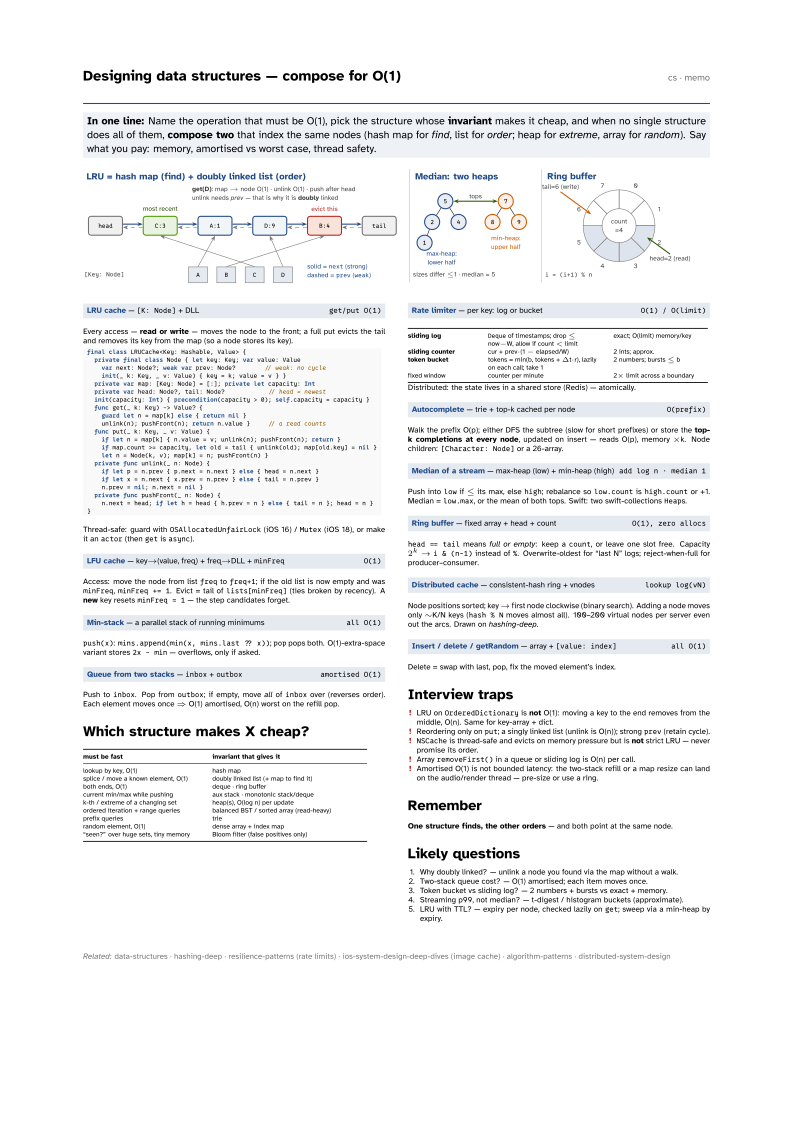

Every access — read or write — moves the node to the front; a full put evicts the tail and removes its key from the map (so a node stores its key).
final class LRUCache<Key: Hashable, Value> {
  private final class Node { let key: Key; var value: Value
    var next: Node?; weak var prev: Node?        // weak: no cycle
    init(_ k: Key, _ v: Value) { key = k; value = v } }
  private var map: [Key: Node] = [:]; private let capacity: Int
  private var head: Node?, tail: Node?            // head = newest
  init(capacity: Int) { precondition(capacity > 0); self.capacity = capacity }
  func get(_ k: Key) -> Value? {
    guard let n = map[k] else { return nil }
    unlink(n); pushFront(n); return n.value }     // a read counts
  func put(_ k: Key, _ v: Value) {
    if let n = map[k] { n.value = v; unlink(n); pushFront(n); return }
    if map.count >= capacity, let old = tail { unlink(old); map[old.key] = nil }
    let n = Node(k, v); map[k] = n; pushFront(n) }
  private func unlink(_ n: Node) {
    if let p = n.prev { p.next = n.next } else { head = n.next }
    if let x = n.next { x.prev = n.prev } else { tail = n.prev }
    n.prev = nil; n.next = nil }
  private func pushFront(_ n: Node) {
    n.next = head; if let h = head { h.prev = n } else { tail = n }; head = n }
}
Thread-safe: guard with OSAllocatedUnfairLock (iOS 16) / Mutex (iOS 18), or make it an actor (then get is async).
Access: move the node from list freq to freq+1; if the old list is now empty and was minFreq, minFreq += 1. Evict = tail of lists[minFreq] (ties broken by recency). A new key resets minFreq = 1 — the step candidates forget.
push(x): mins.append(min(x, mins.last ?? x)); pop pops both. O(1)-extra-space variant stores 2x - min — overflows, only if asked.
Push to inbox. Pop from outbox; if empty, move all of inbox over (reverses order). Each element moves once ⇒ O(1) amortised, O(n) worst on the refill pop.
Which structure makes X cheap?
| must be fast | invariant that gives it |
|---|---|
| lookup by key, O(1) | hash map |
| splice / move a known element, O(1) | doubly linked list (+ map to find it) |
| both ends, O(1) | deque · ring buffer |
| current min/max while pushing | aux stack · monotonic stack/deque |
| k-th / extreme of a changing set | heap(s), O(log n) per update |
| ordered iteration + range queries | balanced BST / sorted array (read-heavy) |
| prefix queries | trie |
| random element, O(1) | dense array + index map |
| “seen?” over huge sets, tiny memory | Bloom filter (false positives only) |
| sliding log | Deque of timestamps; drop ≤ now-W, allow if count < limit | exact; O(limit) memory/key |
| sliding counter | cur + prev·(1 - elapsed/W) | 2 ints; approx. |
| token bucket | tokens = min(b, tokens + Δt·r), lazily on each call; take 1 | 2 numbers; bursts ≤ b |
| fixed window | counter per minute | 2× limit across a boundary |
Walk the prefix O(p); either DFS the subtree (slow for short prefixes) or store the top-k completions at every node, updated on insert — reads O(p), memory ×k. Node children: [Character: Node] or a 26-array.
Push into low if ≤ its max, else high; rebalance so low.count is high.count or +1. Median = low.max, or the mean of both tops. Swift: two swift-collections Heaps.
head == tail means full or empty: keep a count, or leave one slot free. Capacity 2k → i & (n-1) instead of %. Overwrite-oldest for “last N” logs; reject-when-full for producer–consumer.
Node positions sorted; key → first node clockwise (binary search). Adding a node moves only ∼K/N keys (hash % N moves almost all). 100–200 virtual nodes per server even out the arcs. Drawn on hashing-deep.
Delete = swap with last, pop, fix the moved element’s index.
Interview traps
- LRU on
OrderedDictionaryis not O(1): moving a key to the end removes from the middle, O(n). Same for key-array + dict. - Reordering only on
put; a singly linked list (unlink is O(n)); strongprev(retain cycle). NSCacheis thread-safe and evicts on memory pressure but is not strict LRU — never promise its order.- Array
removeFirst()in a queue or sliding log is O(n) per call. - Amortised O(1) is not bounded latency: the two-stack refill or a map resize can land on the audio/render thread — pre-size or use a ring.
Remember
One structure finds, the other orders — and both point at the same node.
Likely questions
- Why doubly linked? — unlink a node you found via the map without a walk.
- Two-stack queue cost? — O(1) amortised; each item moves once.
- Token bucket vs sliding log? — 2 numbers + bursts vs exact + memory.
- Streaming p99, not median? — t-digest / histogram buckets (approximate).
- LRU with TTL? — expiry per node, checked lazily on
get; sweep via a min-heap by expiry.