cs · memo
In one line: Every structure is a memory layout plus an invariant that makes some operations cheap and others expensive. Pick by the operation that must be fast, then check the constants: contiguous memory + cache lines beat pointer chasing at equal big-O on every modern CPU.
Download PDF Print view LaTeX source

How each one works
- Array — one contiguous block:
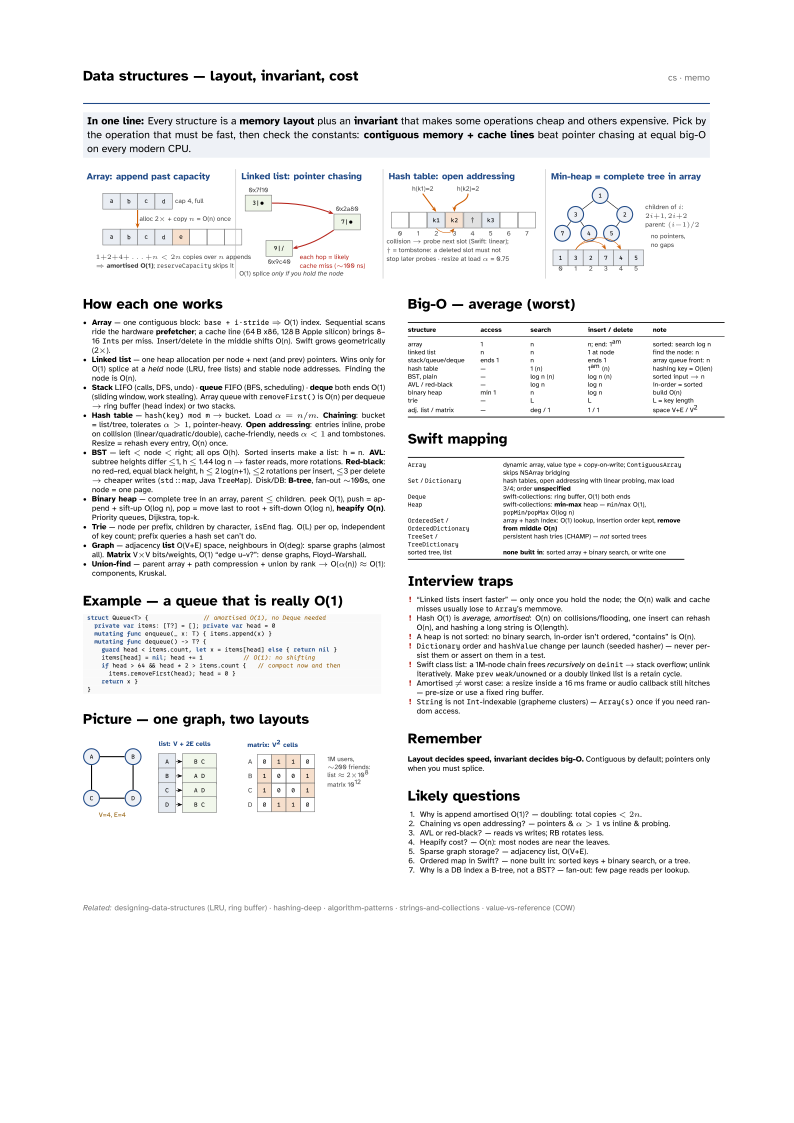
base + i·stride⇒ O(1) index. Sequential scans ride the hardware prefetcher; a cache line (64 B x86, 128 B Apple silicon) brings 8–16Ints per miss. Insert/delete in the middle shifts O(n). Swift grows geometrically (2×). - Linked list — one heap allocation per node + next (and prev) pointers. Wins only for O(1) splice at a held node (LRU, free lists) and stable node addresses. Finding the node is O(n).
- Stack LIFO (calls, DFS, undo) · queue FIFO (BFS, scheduling) · deque both ends O(1) (sliding window, work stealing). Array queue with
removeFirst()is O(n) per dequeue → ring buffer (head index) or two stacks. - Hash table —
hash(key) mod m→ bucket. Load α= n/m. Chaining: bucket = list/tree, tolerates α>1, pointer-heavy. Open addressing: entries inline, probe on collision (linear/quadratic/double), cache-friendly, needs α<1 and tombstones. Resize = rehash every entry, O(n) once. - BST — left < node < right; all ops O(h). Sorted inserts make a list: h = n. AVL: subtree heights differ ≤1, h ≤ 1.44 log n → faster reads, more rotations. Red-black: no red–red, equal black height, h ≤ 2 log(n+1), ≤2 rotations per insert, ≤3 per delete → cheaper writes (
std::map, JavaTreeMap). Disk/DB: B-tree, fan-out ∼100s, one node = one page. - Binary heap — complete tree in an array, parent ≤ children. peek O(1), push = append + sift-up O(log n), pop = move last to root + sift-down O(log n), heapify O(n). Priority queues, Dijkstra, top-k.
- Trie — node per prefix, children by character,
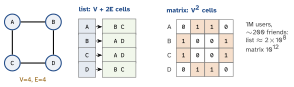
isEndflag. O(L) per op, independent of key count; prefix queries a hash set can’t do. - Graph — adjacency list O(V+E) space, neighbours in O(deg): sparse graphs (almost all). Matrix V×V bits/weights, O(1) “edge u–v?”: dense graphs, Floyd–Warshall.
- Union-find — parent array + path compression + union by rank → O(α(n)) ≈ O(1): components, Kruskal.
Example — a queue that is really O(1)
struct Queue<T> {               // amortised O(1), no Deque needed
  private var items: [T?] = []; private var head = 0
  mutating func enqueue(_ x: T) { items.append(x) }
  mutating func dequeue() -> T? {
    guard head < items.count, let x = items[head] else { return nil }
    items[head] = nil; head += 1           // O(1): no shifting
    if head > 64 && head * 2 > items.count {   // compact now and then
      items.removeFirst(head); head = 0 }
    return x }
}
Picture — one graph, two layouts
Big-O — average (worst)
| structure | access | search | insert / delete | note |
|---|---|---|---|---|
| array | 1 | n | n; end: 1am | sorted: search log n |
| linked list | n | n | 1 at node | find the node: n |
| stack/queue/deque | ends 1 | n | ends 1 | array queue front: n |
| hash table | — | 1 (n) | 1am (n) | hashing key = O(len) |
| BST, plain | — | log n (n) | log n (n) | sorted input → n |
| AVL / red-black | — | log n | log n | in-order = sorted |
| binary heap | min 1 | n | log n | build O(n) |
| trie | — | L | L | L = key length |
| adj. list / matrix | — | deg / 1 | 1 / 1 | space V+E / V2 |
Swift mapping
Array | dynamic array, value type + copy-on-write; ContiguousArray skips NSArray bridging |
Set / Dictionary | hash tables, open addressing with linear probing, max load 3/4; order unspecified |
Deque | swift-collections: ring buffer, O(1) both ends |
Heap | swift-collections: min-max heap — min/max O(1), popMin/popMax O(log n) |
OrderedSet / OrderedDictionary | array + hash index: O(1) lookup, insertion order kept, remove from middle O(n) |
TreeSet / TreeDictionary | persistent hash tries (CHAMP) — not sorted trees |
| sorted tree, list | none built in: sorted array + binary search, or write one |
Interview traps
- “Linked lists insert faster” — only once you hold the node; the O(n) walk and cache misses usually lose to
Array’s memmove. - Hash O(1) is average, amortised: O(n) on collisions/flooding, one insert can rehash O(n), and hashing a long string is O(length).
- A heap is not sorted: no binary search, in-order isn’t ordered, “contains” is O(n).
Dictionaryorder andhashValuechange per launch (seeded hasher) — never persist them or assert on them in a test.- Swift class list: a 1M-node chain frees recursively on
deinit→ stack overflow; unlink iteratively. Makeprevweak/unownedor a doubly linked list is a retain cycle. - Amortised ≠ worst case: a resize inside a 16 ms frame or audio callback still hitches — pre-size or use a fixed ring buffer.
Stringis notInt-indexable (grapheme clusters) —Array(s)once if you need random access.
Remember
Layout decides speed, invariant decides big-O. Contiguous by default; pointers only when you must splice.
Likely questions
- Why is append amortised O(1)? — doubling: total copies <2n.
- Chaining vs open addressing? — pointers & α>1 vs inline & probing.
- AVL or red-black? — reads vs writes; RB rotates less.
- Heapify cost? — O(n): most nodes are near the leaves.
- Sparse graph storage? — adjacency list, O(V+E).
- Ordered map in Swift? — none built in: sorted keys + binary search, or a tree.
- Why is a DB index a B-tree, not a BST? — fan-out: few page reads per lookup.