cs · memo
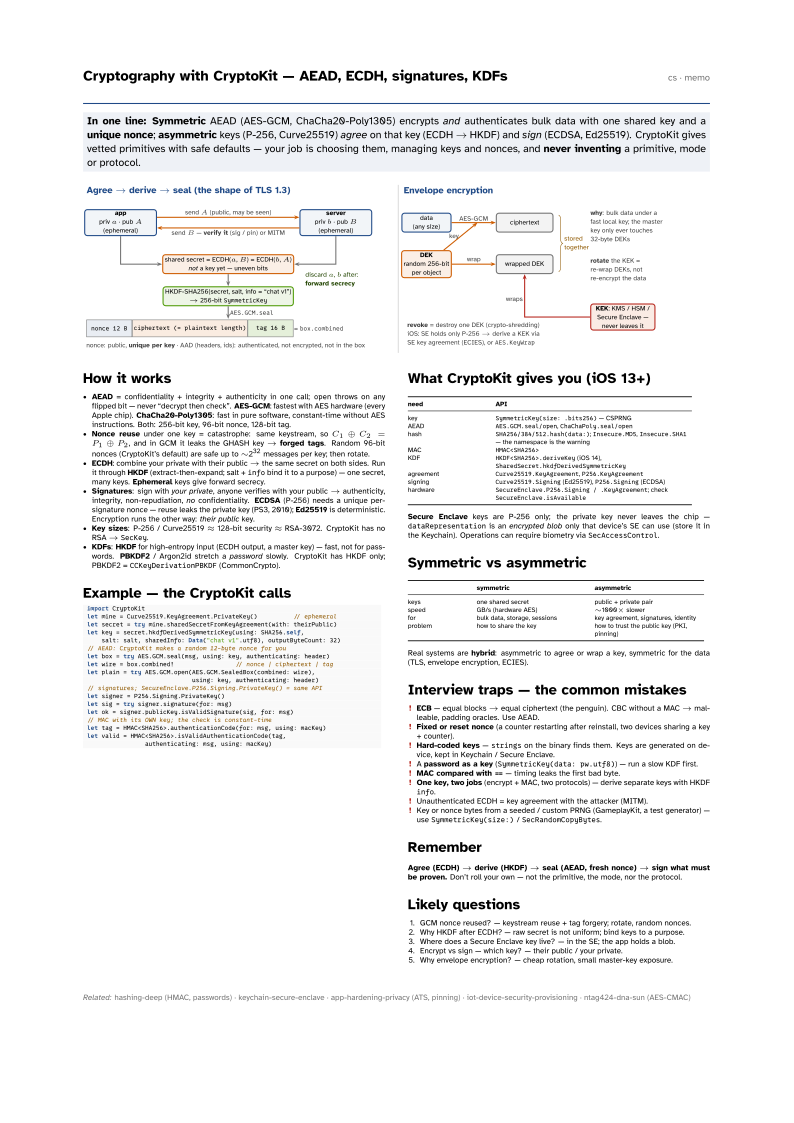
In one line: Symmetric AEAD (AES-GCM, ChaCha20-Poly1305) encrypts and authenticates bulk data with one shared key and a unique nonce; asymmetric keys (P-256, Curve25519) agree on that key (ECDH → HKDF) and sign (ECDSA, Ed25519). CryptoKit gives vetted primitives with safe defaults — your job is choosing them, managing keys and nonces, and never inventing a primitive, mode or protocol.
Download PDF Print view LaTeX source
How it works
- AEAD = confidentiality + integrity + authenticity in one call;
openthrows on any flipped bit — never “decrypt then check”. AES-GCM: fastest with AES hardware (every Apple chip). ChaCha20-Poly1305: fast in pure software, constant-time without AES instructions. Both: 256-bit key, 96-bit nonce, 128-bit tag. - Nonce reuse under one key = catastrophe: same keystream, so C1 ⊕C2 = P1 ⊕P2, and in GCM it leaks the GHASH key → forged tags. Random 96-bit nonces (CryptoKit’s default) are safe up to ∼232 messages per key; then rotate.
- ECDH: combine your private with their public → the same secret on both sides. Run it through HKDF (extract-then-expand; salt +
infobind it to a purpose) — one secret, many keys. Ephemeral keys give forward secrecy. - Signatures: sign with your private, anyone verifies with your public → authenticity, integrity, non-repudiation, no confidentiality. ECDSA (P-256) needs a unique per-signature nonce — reuse leaks the private key (PS3, 2010); Ed25519 is deterministic. Encryption runs the other way: their public key.
- Key sizes: P-256 / Curve25519 ≈ 128-bit security ≈ RSA-3072. CryptoKit has no RSA →
SecKey. - KDFs: HKDF for high-entropy input (ECDH output, a master key) — fast, not for passwords. PBKDF2 / Argon2id stretch a password slowly. CryptoKit has HKDF only; PBKDF2 =
CCKeyDerivationPBKDF(CommonCrypto).
Example — the CryptoKit calls
import CryptoKit
let mine = Curve25519.KeyAgreement.PrivateKey()          // ephemeral
let secret = try mine.sharedSecretFromKeyAgreement(with: theirPublic)
let key = secret.hkdfDerivedSymmetricKey(using: SHA256.self,
    salt: salt, sharedInfo: Data("chat v1".utf8), outputByteCount: 32)
// AEAD: CryptoKit makes a random 12-byte nonce for you
let box = try AES.GCM.seal(msg, using: key, authenticating: header)
let wire = box.combined!                 // nonce | ciphertext | tag
let plain = try AES.GCM.open(AES.GCM.SealedBox(combined: wire),
                             using: key, authenticating: header)
// signatures; SecureEnclave.P256.Signing.PrivateKey() = same API
let signer = P256.Signing.PrivateKey()
let sig = try signer.signature(for: msg)
let ok = signer.publicKey.isValidSignature(sig, for: msg)
// MAC with its OWN key; the check is constant-time
let tag = HMAC<SHA256>.authenticationCode(for: msg, using: macKey)
let valid = HMAC<SHA256>.isValidAuthenticationCode(tag,
                authenticating: msg, using: macKey)
What CryptoKit gives you (iOS 13+)
| need | API |
|---|---|
| key | SymmetricKey(size: .bits256) — CSPRNG |
| AEAD | AES.GCM.seal/open, ChaChaPoly.seal/open |
| hash | SHA256/384/512.hash(data:); Insecure.MD5, Insecure.SHA1 — the namespace is the warning |
| MAC | HMAC<SHA256> |
| KDF | HKDF<SHA256>.deriveKey (iOS 14), SharedSecret.hkdfDerivedSymmetricKey |
| agreement | Curve25519.KeyAgreement, P256.KeyAgreement |
| signing | Curve25519.Signing (Ed25519), P256.Signing (ECDSA) |
| hardware | SecureEnclave.P256.Signing / .KeyAgreement; check SecureEnclave.isAvailable |
Secure Enclave keys are P-256 only; the private key never leaves the chip — dataRepresentation is an encrypted blob only that device’s SE can use (store it in the Keychain). Operations can require biometry via SecAccessControl.
Symmetric vs asymmetric
| symmetric | asymmetric | |
|---|---|---|
| keys | one shared secret | public + private pair |
| speed | GB/s (hardware AES) | ∼1000× slower |
| for | bulk data, storage, sessions | key agreement, signatures, identity |
| problem | how to share the key | how to trust the public key (PKI, pinning) |
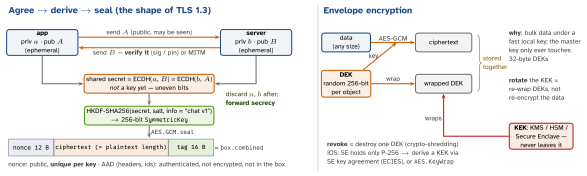
Real systems are hybrid: asymmetric to agree or wrap a key, symmetric for the data (TLS, envelope encryption, ECIES).
Interview traps — the common mistakes
- ECB — equal blocks → equal ciphertext (the penguin). CBC without a MAC → malleable, padding oracles. Use AEAD.
- Fixed or reset nonce (a counter restarting after reinstall, two devices sharing a key + counter).
- Hard-coded keys —
stringson the binary finds them. Keys are generated on device, kept in Keychain / Secure Enclave. - A password as a key (
SymmetricKey(data: pw.utf8)) — run a slow KDF first. - MAC compared with
==— timing leaks the first bad byte. - One key, two jobs (encrypt + MAC, two protocols) — derive separate keys with HKDF
info. - Unauthenticated ECDH = key agreement with the attacker (MITM).
- Key or nonce bytes from a seeded / custom PRNG (GameplayKit, a test generator) — use
SymmetricKey(size:)/SecRandomCopyBytes.
Remember
Agree (ECDH) → derive (HKDF) → seal (AEAD, fresh nonce) → sign what must be proven. Don’t roll your own — not the primitive, the mode, nor the protocol.
Likely questions
- GCM nonce reused? — keystream reuse + tag forgery; rotate, random nonces.
- Why HKDF after ECDH? — raw secret is not uniform; bind keys to a purpose.
- Where does a Secure Enclave key live? — in the SE; the app holds a blob.
- Encrypt vs sign — which key? — their public / your private.
- Why envelope encryption? — cheap rotation, small master-key exposure.