cs · memo
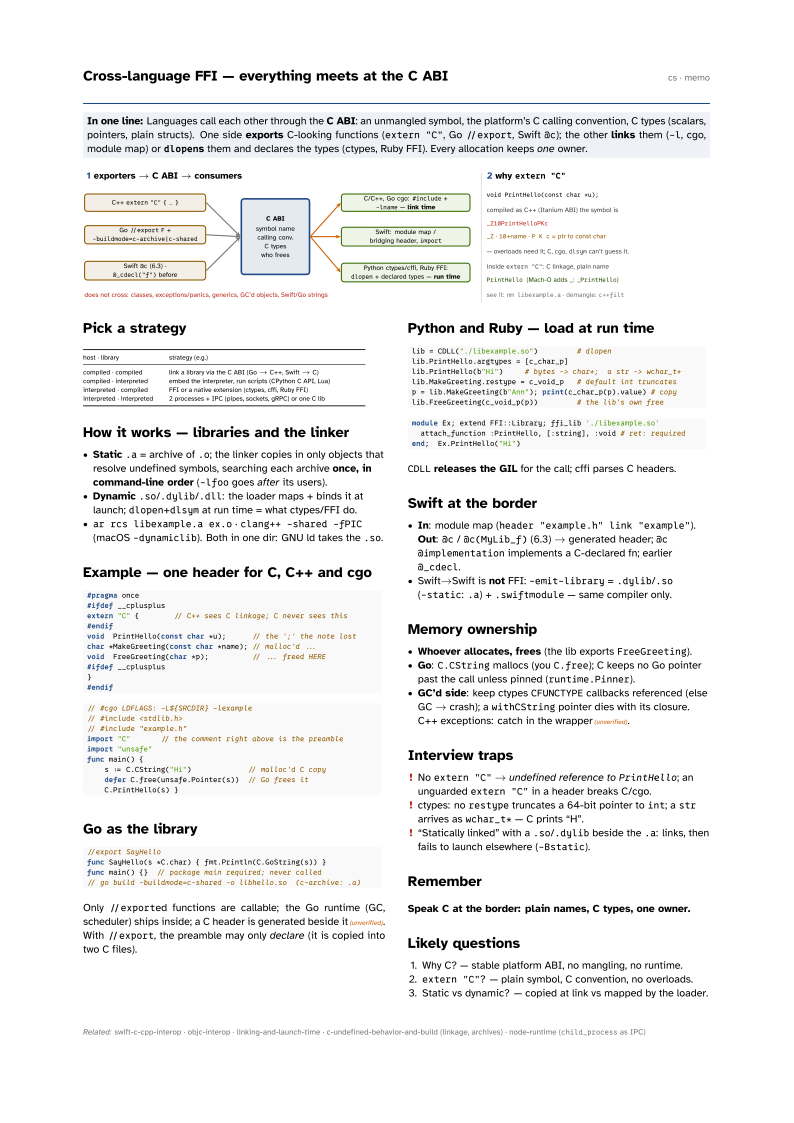
In one line: Languages call each other through the C ABI: an unmangled symbol, the
platform’s C calling convention, C types (scalars, pointers, plain structs). One side
exports C-looking functions (extern "C", Go //export, Swift
@c); the other links them (-l, cgo, module map) or
dlopens them and declares the types (ctypes, Ruby FFI). Every allocation
keeps one owner.
Download PDF Print view LaTeX source
Pick a strategy
| host · library | strategy (e.g.) |
|---|---|
| compiled · compiled | link a library via the C ABI (Go → C++, Swift → C) |
| compiled · interpreted | embed the interpreter, run scripts (CPython C API, Lua) |
| interpreted · compiled | FFI or a native extension (ctypes, cffi, Ruby FFI) |
| interpreted · interpreted | 2 processes + IPC (pipes, sockets, gRPC) or one C lib |
How it works — libraries and the linker
- Static
.a= archive of.o; the linker copies in only objects that resolve undefined symbols, searching each archive once, in command-line order (-lfoogoes after its users). - Dynamic
.so/.dylib/.dll: the loader maps + binds it at launch;dlopen+dlsymat run time = what ctypes/FFI do. ar rcs libexample.a ex.o·clang++ -shared -fPIC(macOS-dynamiclib). Both in one dir: GNU ld takes the.so.
Example — one header for C, C++ and cgo
#pragma once
#ifdef __cplusplus
extern "C" {        // C++ sees C linkage; C never sees this
#endif
void  PrintHello(const char *u);      // the ';' the note lost
char *MakeGreeting(const char *name); // malloc'd ...
void  FreeGreeting(char *p);          // ... freed HERE
#ifdef __cplusplus
}
#endif
// #cgo LDFLAGS: -L${SRCDIR} -lexample
// #include <stdlib.h>
// #include "example.h"
import "C" // the comment right above is the preamble
import "unsafe"
func main() {
s := C.CString("Hi") // malloc'd C copy
defer C.free(unsafe.Pointer(s)) // Go frees it
C.PrintHello(s) }Go as the library
//export SayHello
func SayHello(s *C.char) { fmt.Println(C.GoString(s)) }
func main() {}  // package main required; never called
// go build -buildmode=c-shared -o libhello.so  (c-archive: .a)
Only //exported functions are callable; the Go runtime (GC, scheduler) ships inside; a C header is generated beside it(unverified). With //export, the preamble may only declare (it is copied into two C files).
Python and Ruby — load at run time
lib = CDLL("./libexample.so")         # dlopen
lib.PrintHello.argtypes = [c_char_p]
lib.PrintHello(b"Hi")     # bytes -> char*;  a str -> wchar_t*
lib.MakeGreeting.restype = c_void_p   # default int truncates
p = lib.MakeGreeting(b"Ann"); print(c_char_p(p).value) # copy
lib.FreeGreeting(c_void_p(p))         # the lib's own free
module Ex; extend FFI::Library; ffi_lib './libexample.so'
attach_function :PrintHello, [:string], :void # ret: required
end; Ex.PrintHello("Hi")CDLL releases the GIL for the call; cffi parses C headers.
Swift at the border
- In: module map (
header "example.h" link "example"). Out:@c/@c(MyLib_f)(6.3) → generated header;@c @implementationimplements a C-declared fn; earlier@_cdecl. - Swift→Swift is not FFI:
-emit-library=.dylib/.so(-static:.a) +.swiftmodule— same compiler only.
Memory ownership
- Whoever allocates, frees (the lib exports
FreeGreeting). - Go:
C.CStringmallocs (youC.free); C keeps no Go pointer past the call unless pinned (runtime.Pinner). - GC’d side: keep ctypes
CFUNCTYPEcallbacks referenced (else GC → crash); awithCStringpointer dies with its closure. C++ exceptions: catch in the wrapper(unverified).
Interview traps
- No
extern "C"→ undefined reference toPrintHello; an unguardedextern "C"in a header breaks C/cgo. - ctypes: no
restypetruncates a 64-bit pointer toint; astrarrives aswchar_t*— C prints “H”. - “Statically linked” with a
.so/.dylibbeside the.a: links, then fails to launch elsewhere (-Bstatic).
Remember
Speak C at the border: plain names, C types, one owner.
Likely questions
- Why C? — stable platform ABI, no mangling, no runtime.
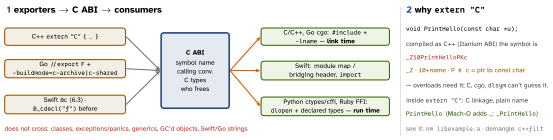
extern "C"? — plain symbol, C convention, no overloads.- Static vs dynamic? — copied at link vs mapped by the loader.