c · memo
In one line: volatile is a promise about the compiler: every read
and write in the source becomes a real load/store, never cached in a register or
removed. It gives no atomicity, no ordering of ordinary memory
and no CPU barrier. State shared by a task and an ISR or another core
needs _Atomic or a critical section.
Download PDF Print view LaTeX source
What volatile does
- Each access is observable behaviour: emitted, never merged or dropped, not reordered against other volatile accesses.
- The ISR-flag bug: without it
while(!flag){}is read once (nothing in the loop writes it) →if(!flag) for(;;);. - For: memory-mapped registers (a read may pop a FIFO or clear a status bit), vars written by an ISR,
volatile
 sig_atomic_t
signal flags, locals live acrosslongjmp. volatile uint32_t *r= pointer to volatile (registers);uint32_t *volatile p= volatile pointer (rarely meant).
What volatile does NOT do
- Atomicity:
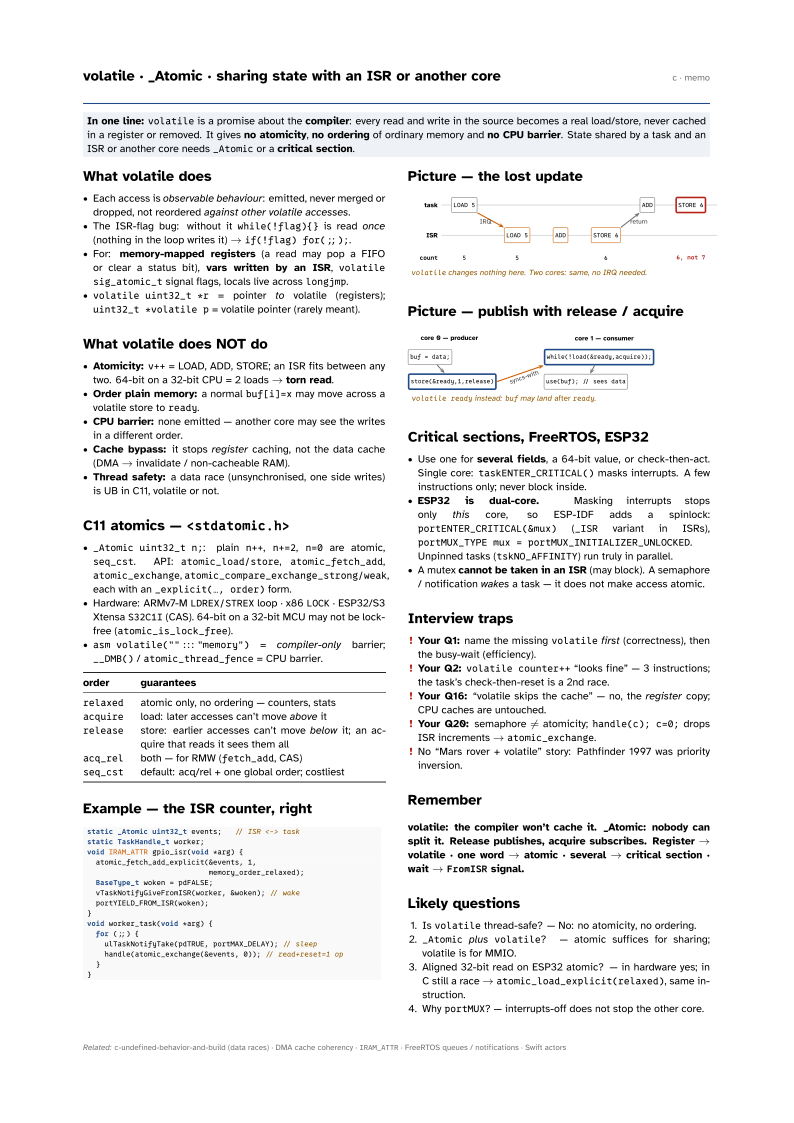
v++= LOAD, ADD, STORE; an ISR fits between any two. 64-bit on a 32-bit CPU = 2 loads → torn read. - Order plain memory: a normal
buf[i]=xmay move across a volatile store toready. - CPU barrier: none emitted — another core may see the writes in a different order.
- Cache bypass: it stops register caching, not the data cache (DMA → invalidate / non-cacheable RAM).
- Thread safety: a data race (unsynchronised, one side writes) is UB in C11, volatile or not.
C11 atomics — <stdatomic.h>
_Atomic uint32_t n;: plainn++,n+=2,n=0are atomic,seq_cst. API:atomic_load/store,atomic_fetch_add,atomic_exchange,atomic_compare_exchange_strong/weak, each with an_explicit(…, order)form.- Hardware: ARMv7-M
LDREX/STREXloop · x86LOCK· ESP32/S3 XtensaS32C1I(CAS). 64-bit on a 32-bit MCU may not be lock-free (atomic_is_lock_free). asm volatile("":::"memory")= compiler-only barrier;__DMB()/atomic_thread_fence= CPU barrier.
| order | guarantees |
|---|---|
relaxed | atomic only, no ordering — counters, stats |
acquire | load: later accesses can’t move above it |
release | store: earlier accesses can’t move below it; an acquire that reads it sees them all |
acq_rel | both — for RMW (fetch_add, CAS) |
seq_cst | default: acq/rel + one global order; costliest |
Example — the ISR counter, right
static _Atomic uint32_t events;   // ISR <-> task
static TaskHandle_t worker;
void IRAM_ATTR gpio_isr(void *arg) {
  atomic_fetch_add_explicit(&events, 1,
                            memory_order_relaxed);
  BaseType_t woken = pdFALSE;
  vTaskNotifyGiveFromISR(worker, &woken); // wake
  portYIELD_FROM_ISR(woken);
}
void worker_task(void *arg) {
  for (;;) {
    ulTaskNotifyTake(pdTRUE, portMAX_DELAY); // sleep
    handle(atomic_exchange(&events, 0)); // read+reset=1 op
  }
}
Picture — the lost update
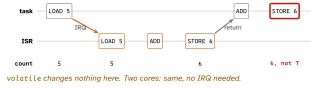
Picture — publish with release / acquire
Critical sections, FreeRTOS, ESP32
- Use one for several fields, a 64-bit value, or check-then-act. Single core:
taskENTER_CRITICAL()masks interrupts. A few instructions only; never block inside. - ESP32 is dual-core. Masking interrupts stops only this core, so ESP-IDF adds a spinlock:
portENTER_CRITICAL(&mux)(_ISRvariant in ISRs),portMUX_TYPE mux = portMUX_INITIALIZER_UNLOCKED. Unpinned tasks (tskNO_AFFINITY) run truly in parallel. - A mutex cannot be taken in an ISR (may block). A semaphore / notification wakes a task — it does not make access atomic.
Interview traps
- Your Q1: name the missing
volatilefirst (correctness), then the busy-wait (efficiency). - Your Q2:
volatile counter++“looks fine” — 3 instructions; the task’s check-then-reset is a 2nd race. - Your Q16: “volatile skips the cache” — no, the register copy; CPU caches are untouched.
- Your Q20: semaphore ≠ atomicity;
handle(c); c=0;drops ISR increments →atomic_exchange. - No “Mars rover + volatile” story: Pathfinder 1997 was priority inversion.
Remember
volatile: the compiler won’t cache it. _Atomic: nobody can split it.
Release publishes, acquire subscribes. Register → volatile · one word →
atomic · several → critical section · wait → FromISR signal.
Likely questions
- Is
volatilethread-safe? — No: no atomicity, no ordering. _Atomicplusvolatile? — atomic suffices for sharing; volatile is for MMIO.- Aligned 32-bit read on ESP32 atomic? — in hardware yes; in C still a race →
atomic_load_explicit(relaxed), same instruction. - Why
portMUX? — interrupts-off does not stop the other core.