c · memo
In one line: Read a declaration from the name outward: right first
([], ()), then left (*, const).
const guards what is immediately left of it (or right, if it
is first). restrict promises “this pointer is the only way to that
memory”. A pointer is valid only while its object lives.
Download PDF Print view LaTeX source
Reading declarations
| declaration | read as · allowed |
|---|---|
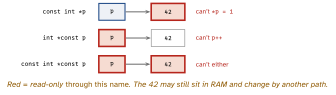
const int *p | ptr to const int · p++ ok, *p=1 error |
int const *p | identical to the line above |
int *const p | const ptr to int · *p=1 ok, p++ error |
const int *const p | neither moves nor writes |
int **pp | ptr to ptr — a callee can reseat your ptr |
int *a[5] | array of 5 pointers to int |
int (*a)[5] | pointer to an array of 5 ints |
int *f(void) | function returning int * |
int (*f)(void) | pointer to function returning int |
char *(*x[3])(int) | array of 3 ptrs to fn(int) → char * |
Rule of thumb: const left of * = the data is read-only; right of * = the pointer is fixed. Registers: volatile uint32_t *const REG = (volatile uint32_t *)0x3FF4403C;
Function pointers + void *ctx
typedef void (*event_cb)(uint8_t evt, void *ctx);
typedef struct { event_cb cb; void *ctx; } listener;
static void on_evt(uint8_t evt, void *ctx) {
  counter *c = ctx;          // void* -> T*: no cast in C
  c->n++;                    // C's "closure": fn + state
}
static counter clicks;       // ctx must OUTLIVE the listener
listener l = { on_evt, &clicks };
l.cb(EVT_PRESS, l.ctx);      // == (*l.cb)(EVT_PRESS, l.ctx)
static const event_cb table[] = { [EVT_A] = on_a,
                                  [EVT_B] = on_b }; // dispatch
restrict — “I am the only door”
int f(int *a, int *b) { *a = 1; *b = 2; return *a; }
int g(int *restrict a, int *restrict b)
                      { *a = 1; *b = 2; return *a; }
// f must reload *a (b may == a); g may just return 1- Gain: values stay in registers, loads/stores reorder, loops vectorise. Breaking the promise = UB, no diagnostic.
memcpy(void *restrict, const void *restrict, size_t)— overlap is UB.memmovehas norestrict: copies in the safe direction.memmove(buf+2, buf, n)to shift in place.- C99 keyword; C++ has only the
__restrictextension.
Arrays, decay, arithmetic
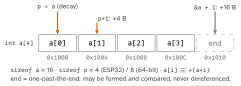
- An array name decays to
&a[0]except undersizeof, unary&, and a string literal initialising achararray.&aisint (*)[4]. - Parameter
int a[10]isint *a: inside,sizeof a= pointer size, sosizeof a / sizeof a[0]lies. Pass a length. p + nmovesn * sizeof *pbytes;q - p= element count (ptrdiff_t), same array only. No arithmetic onvoid *in standard C (GCC treats it as bytes).
Picture — which part is read-only?
Picture — decay, arithmetic, sizeof
Dangling pointers — and the fixes
- Return of a local:
char buf[32]; return buf;— the frame is popped; it may “work” until the next call overwrites it. Fix: caller-provided buffer + size (embedded default),static(not re-entrant), ormalloc(caller frees). - Use-after-free / double free:
free(p); p = NULL;(free(NULL)is a no-op). reallocmay move: every old pointer dangles;p = realloc(p, n)leakspon failure — use a temp.- A
ctxpointing at a stack variable, registered as a callback from a function that returns = dangling on the first event.
Interview traps
- Your Q3/Q18: could not write “pointer to const” vs “const pointer” — say the name, go right, then left.
- Your Q6: blamed the missing
\0;char buf[32]="hello world"has one. The bug is lifetime. - Your Q15/Q31:
restrict= no-aliasing promise; overlap →memmove, nevermemcpy. const≠ ROM:const int *pmay point at writable RAM.char **→const char **is not an implicit conversion.char *s = "hi"; s[0]='H';is UB — usechar s[] = "hi";.
Remember
Name, right, left. const guards its left neighbour. restrict = only door. A pointer never outlives its object.
Likely questions
uint32_t *p; p+1? — address + 4.- Return a string from a function, embedded? — caller passes
buf, len. - Why is
memcpyfaster thanmemmove? — may assume no overlap. - When
int **? — out-param that allocates,argv, jagged arrays.