c · memo
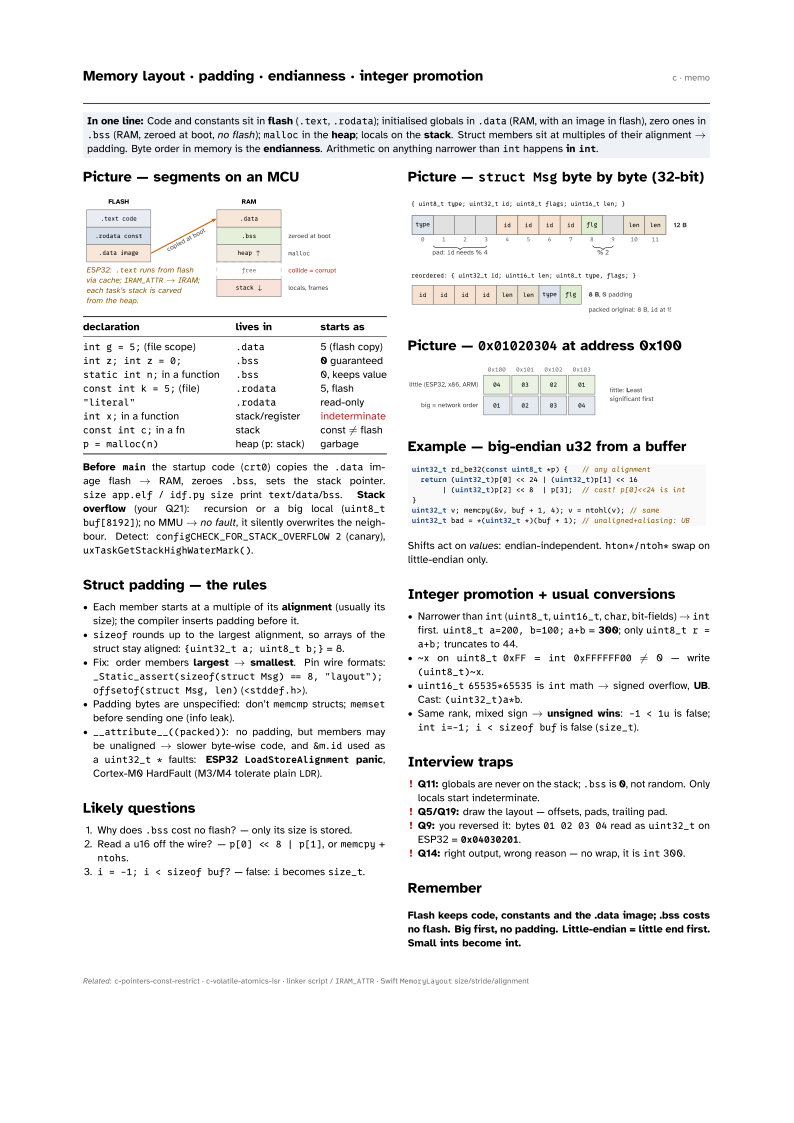
In one line: Code and constants sit in flash (.text,
.rodata); initialised globals in .data (RAM, with an image in
flash), zero ones in .bss (RAM, zeroed at boot, no flash);
malloc in the heap; locals on the stack. Struct
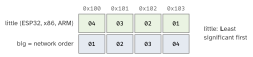
members sit at multiples of their alignment → padding. Byte order in memory
is the endianness. Arithmetic on anything narrower than int
happens in int.
Download PDF Print view LaTeX source
Picture — segments on an MCU
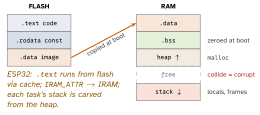
| declaration | lives in | starts as |
|---|---|---|
int g = 5; (file scope) | .data | 5 (flash copy) |
int z; int z = 0; | .bss | 0 guaranteed |
static int n; in a function | .bss | 0, keeps value |
const int k = 5; (file) | .rodata | 5, flash |
"literal" | .rodata | read-only |
int x; in a function | stack/register | indeterminate |
const int c; in a fn | stack | const ≠ flash |
p = malloc(n) | heap (p: stack) | garbage |
Before main the startup code (crt0) copies the .data image flash → RAM, zeroes .bss, sets the stack pointer. size app.elf / idf.py size print text/data/bss. Stack overflow (your Q21): recursion or a big local (uint8_t buf[8192]); no MMU → no fault, it silently overwrites the neighbour. Detect: configCHECK_FOR_STACK_OVERFLOW 2 (canary), uxTaskGetStackHighWaterMark().
Struct padding — the rules
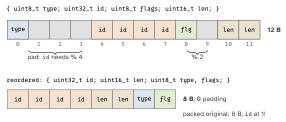
- Each member starts at a multiple of its alignment (usually its size); the compiler inserts padding before it.
sizeofrounds up to the largest alignment, so arrays of the struct stay aligned:{uint32_t a; uint8_t b;}= 8.- Fix: order members largest → smallest. Pin wire formats:
_Static_assert(sizeof(struct Msg) == 8, "layout");offsetof(struct Msg, len)(<stddef.h>). - Padding bytes are unspecified: don’t
memcmpstructs;memsetbefore sending one (info leak). __attribute__((packed)): no padding, but members may be unaligned → slower byte-wise code, and&m.idused as auint32_t *faults: ESP32LoadStoreAlignmentpanic, Cortex-M0 HardFault (M3/M4 tolerate plainLDR).
Likely questions
- Why does
.bsscost no flash? — only its size is stored. - Read a u16 off the wire? —
p[0] << 8 | p[1], ormemcpy+ntohs. i = -1; i < sizeof buf? — false:ibecomessize_t.
Picture — struct Msg byte by byte (32-bit)
Picture — 0x01020304 at address 0x100
Example — big-endian u32 from a buffer
uint32_t rd_be32(const uint8_t *p) {   // any alignment
  return (uint32_t)p[0] << 24 | (uint32_t)p[1] << 16
       | (uint32_t)p[2] << 8  | p[3];  // cast! p[0]<<24 is int
}
uint32_t v; memcpy(&v, buf + 1, 4); v = ntohl(v); // same
uint32_t bad = *(uint32_t *)(buf + 1); // unaligned+aliasing: UB
Shifts act on values: endian-independent. hton*/ntoh* swap on little-endian only.
Integer promotion + usual conversions
- Narrower than
int(uint8_t,uint16_t,char, bit-fields) →intfirst.uint8_t a=200, b=100;a+b= 300; onlyuint8_t r = a+b;truncates to 44. ~xonuint8_t 0xFF=int0xFFFFFF00≠ 0 — write(uint8_t)~x.uint16_t65535*65535isintmath → signed overflow, UB. Cast:(uint32_t)a*b.- Same rank, mixed sign → unsigned wins:
-1 < 1uis false;int i=-1; i < sizeof bufis false (size_t).
Interview traps
- Q11: globals are never on the stack;
.bssis 0, not random. Only locals start indeterminate. - Q5/Q19: draw the layout — offsets, pads, trailing pad.
- Q9: you reversed it: bytes
01 02 03 04read asuint32_ton ESP32 =0x04030201. - Q14: right output, wrong reason — no wrap, it is
int300.