c · memo
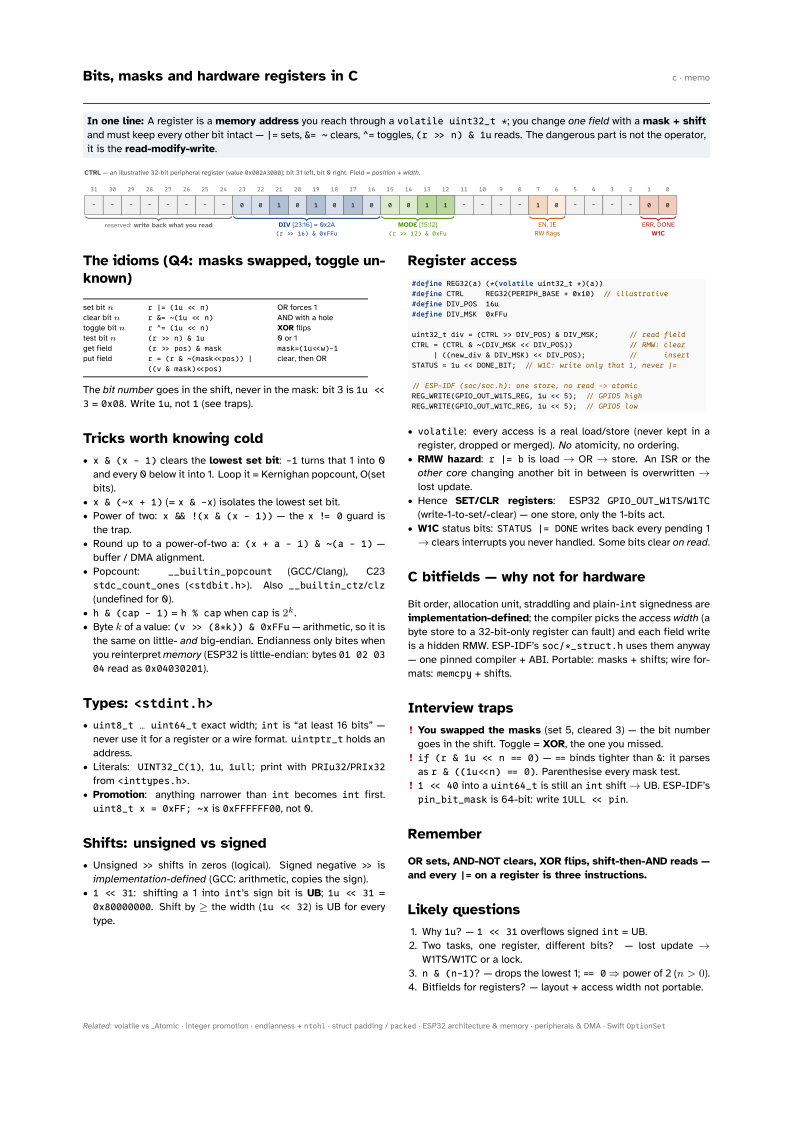
In one line: A register is a memory address you reach through a
volatile uint32_t *; you change one field with a
mask + shift and must keep every other bit intact —
|= sets, &= ~ clears, ̂= toggles,
(r >> n) & 1u reads. The dangerous part is not the operator, it is the
read-modify-write.
Download PDF Print view LaTeX source

The idioms (Q4: masks swapped, toggle unknown)
| set bit n | r |= (1u << n) | OR forces 1 |
| clear bit n | r &= ~(1u << n) | AND with a hole |
| toggle bit n | r ̂= (1u << n) | XOR flips |
| test bit n | (r >> n) & 1u | 0 or 1 |
| get field | (r >> pos) & mask | mask=(1u<<w)-1 |
| put field | r = (r & ~(mask<<pos)) | ((v & mask)<<pos) | clear, then OR |
1u << 3 = 0x08. Write 1u, not 1 (see traps).
Tricks worth knowing cold
x & (x - 1)clears the lowest set bit:-1turns that 1 into 0 and every 0 below it into 1. Loop it = Kernighan popcount, O(set bits).x & (~x + 1)(=x & -x) isolates the lowest set bit.- Power of two:
x && !(x & (x - 1))— thex != 0guard is the trap. - Round up to a power-of-two
a:(x + a - 1) & ~(a - 1)— buffer / DMA alignment. - Popcount:
__builtin_popcount(GCC/Clang), C23stdc_count_ones(<stdbit.h>). Also__builtin_ctz/clz(undefined for 0). h & (cap - 1)=h % capwhencapis 2k.- Byte k of a value:
(v >> (8*k)) & 0xFFu— arithmetic, so it is the same on little- and big-endian. Endianness only bites when you reinterpret memory (ESP32 is little-endian: bytes01 02 03 04read as0x04030201).
Types: <stdint.h>
uint8_t … uint64_texact width;intis “at least 16 bits” — never use it for a register or a wire format.uintptr_tholds an address.- Literals:
UINT32_C(1),1u,1ull; print withPRIu32/PRIx32from<inttypes.h>. - Promotion: anything narrower than
intbecomesintfirst.uint8_t x = 0xFF; ~xis0xFFFFFF00, not 0.
Shifts: unsigned vs signed
- Unsigned
>>shifts in zeros (logical). Signed negative>>is implementation-defined (GCC: arithmetic, copies the sign). 1 << 31: shifting a 1 intoint’s sign bit is UB;1u << 31=0x80000000. Shift by ≥ the width (1u << 32) is UB for every type.
Register access
#define REG32(a) (*(volatile uint32_t *)(a))
#define CTRL     REG32(PERIPH_BASE + 0x10)  // illustrative
#define DIV_POS  16u
#define DIV_MSK  0xFFu

uint32_t div = (CTRL >> DIV_POS) & DIV_MSK;       // read field
CTRL = (CTRL & ~(DIV_MSK << DIV_POS))             // RMW: clear
     | ((new_div & DIV_MSK) << DIV_POS);          //      insert
STATUS = 1u << DONE_BIT;  // W1C: write only that 1, never |=

// ESP-IDF (soc/soc.h): one store, no read -> atomic
REG_WRITE(GPIO_OUT_W1TS_REG, 1u << 5);  // GPIO5 high
REG_WRITE(GPIO_OUT_W1TC_REG, 1u << 5); // GPIO5 lowvolatile: every access is a real load/store (never kept in a register, dropped or merged). No atomicity, no ordering.- RMW hazard:
r |= bis load → OR → store. An ISR or the other core changing another bit in between is overwritten → lost update. - Hence SET/CLR registers: ESP32
GPIO_OUT_W1TS/W1TC(write-1-to-set/-clear) — one store, only the 1-bits act. - W1C status bits:
STATUS |= DONEwrites back every pending 1 → clears interrupts you never handled. Some bits clear on read.
C bitfields — why not for hardware
Bit order, allocation unit, straddling and plain-int signedness are implementation-defined; the compiler picks the access width (a byte store to a 32-bit-only register can fault) and each field write is a hidden RMW. ESP-IDF’s soc/*_struct.h uses them anyway — one pinned compiler + ABI. Portable: masks + shifts; wire formats: memcpy + shifts.
Interview traps
- You swapped the masks (set 5, cleared 3) — the bit number goes in the shift. Toggle = XOR, the one you missed.
if (r & 1u << n == 0)—==binds tighter than&: it parses asr & ((1u<<n) == 0). Parenthesise every mask test.1 << 40into auint64_tis still anintshift → UB. ESP-IDF’spin_bit_maskis 64-bit: write1ULL << pin.
Remember
OR sets, AND-NOT clears, XOR flips, shift-then-AND reads — and every
|= on a register is three instructions.
Likely questions
- Why
1u? —1 << 31overflows signedint= UB. - Two tasks, one register, different bits? — lost update → W1TS/W1TC or a lock.
n & (n-1)? — drops the lowest 1;== 0⇒ power of 2 (n>0).- Bitfields for registers? — layout + access width not portable.