architecture · memo
In one line: Single responsibility · Open/closed · Liskov substitution · Interface segregation · Dependency inversion — Robert C. Martin’s rules for code whose parts can change independently. Interviewers want the exact definition, one iOS example, and which pattern serves it.
Download PDF Print view LaTeX source
How it works — definition · iOS example
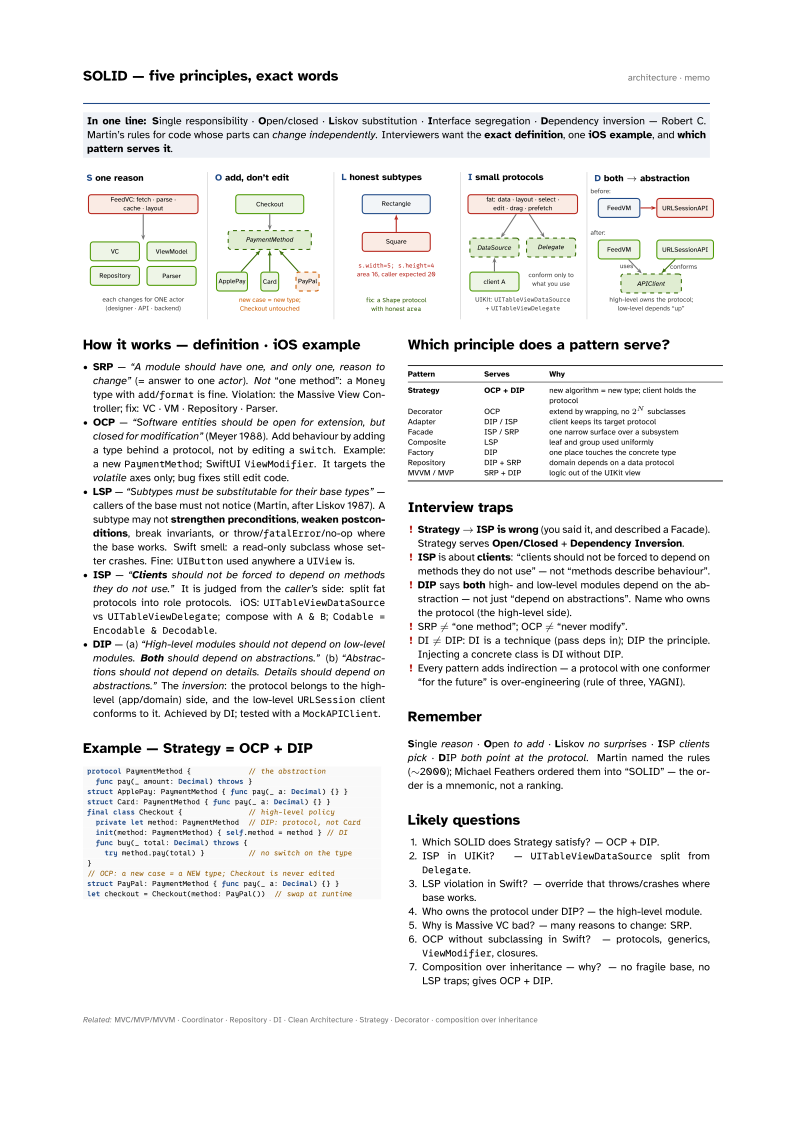
- SRP — “A module should have one, and only one, reason to
change” (= answer to one actor). Not “one method”: a
Moneytype withadd/formatis fine. Violation: the Massive View Controller; fix: VC · VM · Repository · Parser. - OCP — “Software entities should be open for extension, but
closed for modification” (Meyer 1988). Add behaviour by adding a type behind a protocol, not by editing a
switch. Example: a newPaymentMethod; SwiftUIViewModifier. It targets the volatile axes only; bug fixes still edit code. - LSP — “Subtypes must be substitutable for their base
types” — callers of the base must not notice (Martin, after Liskov 1987). A subtype may not strengthen preconditions, weaken
postconditions, break invariants, or throw/
fatalError/no-op where the base works. Swift smell: a read-only subclass whose setter crashes. Fine:UIButtonused anywhere aUIViewis. - ISP — “Clients should not be forced to depend on
methods they do not use.” It is judged from the caller’s side: split fat protocols into role protocols. iOS:
UITableViewDataSourcevsUITableViewDelegate; compose withA & B;Codable = Encodable & Decodable. - DIP — (a) “High-level modules should not depend on low-level
modules. Both should depend on abstractions.” (b) “Abstractions
should not depend on details. Details should depend on abstractions.” The inversion: the protocol belongs to the high-level (app/domain) side, and the low-level
URLSessionclient conforms to it. Achieved by DI; tested with aMockAPIClient.
Example — Strategy = OCP + DIP
protocol PaymentMethod {             // the abstraction
  func pay(_ amount: Decimal) throws }
struct ApplePay: PaymentMethod { func pay(_ a: Decimal) {} }
struct Card: PaymentMethod { func pay(_ a: Decimal) {} }
final class Checkout {               // high-level policy
  private let method: PaymentMethod  // DIP: protocol, not Card
  init(method: PaymentMethod) { self.method = method } // DI
  func buy(_ total: Decimal) throws {
    try method.pay(total) }          // no switch on the type
}
// OCP: a new case = a NEW type; Checkout is never edited
struct PayPal: PaymentMethod { func pay(_ a: Decimal) {} }
let checkout = Checkout(method: PayPal())  // swap at runtime
Which principle does a pattern serve?
| Pattern | Serves | Why |
|---|---|---|
| Strategy | OCP + DIP | new algorithm = new type; client holds the protocol |
| Decorator | OCP | extend by wrapping, no 2N subclasses |
| Adapter | DIP / ISP | client keeps its target protocol |
| Facade | ISP / SRP | one narrow surface over a subsystem |
| Composite | LSP | leaf and group used uniformly |
| Factory | DIP | one place touches the concrete type |
| Repository | DIP + SRP | domain depends on a data protocol |
| MVVM / MVP | SRP + DIP | logic out of the UIKit view |
Interview traps
- Strategy → ISP is wrong (you said it, and described a Facade). Strategy serves Open/Closed + Dependency Inversion.
- ISP is about clients: “clients should not be forced to depend on methods they do not use” — not “methods describe behaviour”.
- DIP says both high- and low-level modules depend on the abstraction — not just “depend on abstractions”. Name who owns the protocol (the high-level side).
- SRP ≠ “one method”; OCP ≠ “never modify”.
- DI ≠ DIP: DI is a technique (pass deps in); DIP the principle. Injecting a concrete class is DI without DIP.
- Every pattern adds indirection — a protocol with one conformer “for the future” is over-engineering (rule of three, YAGNI).
Remember
Single reason · Open to add · Liskov no surprises · ISP clients pick · DIP both point at the protocol. Martin named the rules (∼2000); Michael Feathers ordered them into “SOLID” — the order is a mnemonic, not a ranking.
Likely questions
- Which SOLID does Strategy satisfy? — OCP + DIP.
- ISP in UIKit? —
UITableViewDataSourcesplit fromDelegate. - LSP violation in Swift? — override that throws/crashes where base works.
- Who owns the protocol under DIP? — the high-level module.
- Why is Massive VC bad? — many reasons to change: SRP.
- OCP without subclassing in Swift? — protocols, generics,
ViewModifier, closures. - Composition over inheritance — why? — no fragile base, no LSP traps; gives OCP + DIP.