ai · memo
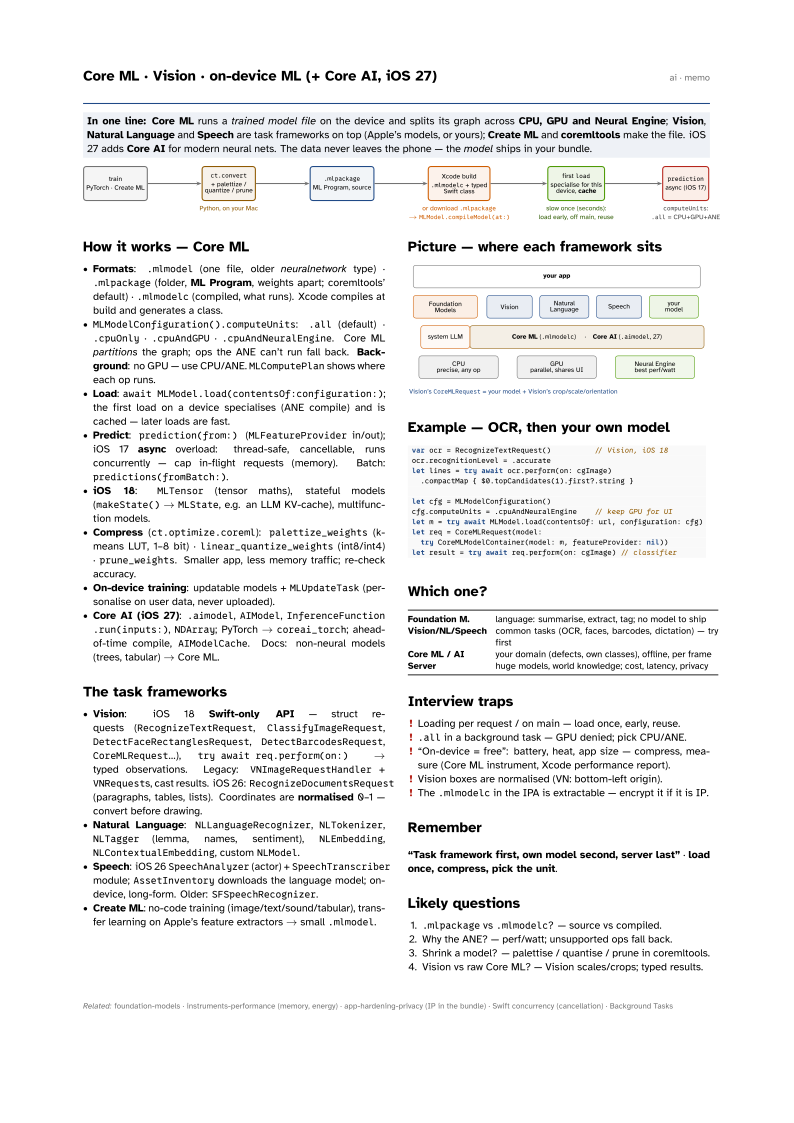
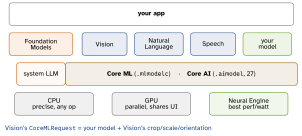
In one line: Core ML runs a trained model file on the device and splits its graph across CPU, GPU and Neural Engine; Vision, Natural Language and Speech are task frameworks on top (Apple’s models, or yours); Create ML and coremltools make the file. iOS 27 adds Core AI for modern neural nets. The data never leaves the phone — the model ships in your bundle.
Download PDF Print view LaTeX source

How it works — Core ML
- Formats:
.mlmodel(one file, older neuralnetwork type) ·.mlpackage(folder, ML Program, weights apart; coremltools’ default) ·.mlmodelc(compiled, what runs). Xcode compiles at build and generates a class. MLModelConfiguration().computeUnits:.all(default) ·.cpuOnly·.cpuAndGPU·.cpuAndNeuralEngine. Core ML partitions the graph; ops the ANE can’t run fall back. Background: no GPU — use CPU/ANE.MLComputePlanshows where each op runs.- Load:
await MLModel.load(contentsOf:configuration:); the first load on a device specialises (ANE compile) and is cached — later loads are fast. - Predict:
prediction(from:)(MLFeatureProviderin/out); iOS 17 async overload: thread-safe, cancellable, runs concurrently — cap in-flight requests (memory). Batch:predictions(fromBatch:). - iOS 18:
MLTensor(tensor maths), stateful models (makeState()→MLState, e.g. an LLM KV-cache), multifunction models. - Compress (
ct.optimize.coreml):palettize_weights(k-means LUT, 1–8 bit) ·linear_quantize_weights(int8/int4) ·prune_weights. Smaller app, less memory traffic; re-check accuracy. - On-device training: updatable models +
MLUpdateTask(personalise on user data, never uploaded). - Core AI (iOS 27):
.aimodel,AIModel,InferenceFunction.run(inputs:),NDArray; PyTorch →coreai_torch; ahead-of-time compile,AIModelCache. Docs: non-neural models (trees, tabular) → Core ML.
The task frameworks
- Vision: iOS 18 Swift-only API — struct requests (
RecognizeTextRequest,ClassifyImageRequest,DetectFaceRectanglesRequest,DetectBarcodesRequest,CoreMLRequest…),try await req.perform(on:)→ typed observations. Legacy:VNImageRequestHandler+VNRequests, cast results. iOS 26:RecognizeDocumentsRequest(paragraphs, tables, lists). Coordinates are normalised 0–1 — convert before drawing. - Natural Language:
NLLanguageRecognizer,NLTokenizer,NLTagger(lemma, names, sentiment),NLEmbedding,NLContextualEmbedding, customNLModel. - Speech: iOS 26
SpeechAnalyzer(actor) +SpeechTranscribermodule;AssetInventorydownloads the language model; on-device, long-form. Older:SFSpeechRecognizer. - Create ML: no-code training (image/text/sound/tabular), transfer learning on Apple’s feature extractors → small
.mlmodel.
Picture — where each framework sits
Example — OCR, then your own model
var ocr = RecognizeTextRequest()          // Vision, iOS 18
ocr.recognitionLevel = .accurate
let lines = try await ocr.perform(on: cgImage)
  .compactMap { $0.topCandidates(1).first?.string }

let cfg = MLModelConfiguration()
cfg.computeUnits = .cpuAndNeuralEngine    // keep GPU for UI
let m = try await MLModel.load(contentsOf: url, configuration: cfg)
let req = CoreMLRequest(model:
  try CoreMLModelContainer(model: m, featureProvider: nil))
let result = try await req.perform(on: cgImage) // classifier
Which one?
| Foundation M. | language: summarise, extract, tag; no model to ship |
| Vision/NL/Speech | common tasks (OCR, faces, barcodes, dictation) — try first |
| Core ML / AI | your domain (defects, own classes), offline, per frame |
| Server | huge models, world knowledge; cost, latency, privacy |
Interview traps
- Loading per request / on main — load once, early, reuse.
.allin a background task — GPU denied; pick CPU/ANE.- “On-device = free”: battery, heat, app size — compress, measure (Core ML instrument, Xcode performance report).
- Vision boxes are normalised (VN: bottom-left origin).
- The
.mlmodelcin the IPA is extractable — encrypt it if it is IP.
Remember
“Task framework first, own model second, server last” · load once, compress, pick the unit.
Likely questions
.mlpackagevs.mlmodelc? — source vs compiled.- Why the ANE? — perf/watt; unsupported ops fall back.
- Shrink a model? — palettise / quantise / prune in coremltools.
- Vision vs raw Core ML? — Vision scales/crops; typed results.